


From the Field to the Dashboard – Built by Experts, for Experts.
Discover What's Really Happening in the Steel Industry
Use the AI-powered search engine to analyze production activity, market trends, and news faster than ever before.
Try the Free AI Search EngineAsia’s Steel Market Sees Positive Upsurge Amid U.S.-Iran Peace Deal
Recent developments in Asia’s steel market are buoyed by newfound optimism following the U.S.-Iran peace deal, illustrating positive shifts in steel plant activities across the region. Key articles such as “U.S.-Iran peace Deal to boost steel industry profits“ and “Dozens of ships transit Hormuz via Omani corridor“ highlight significant changes in shipping routes and cost efficiencies crucial for steel manufacturing. Notably, observed activity levels at numerous steel plants reflect this optimism but show varying degrees of engagement.
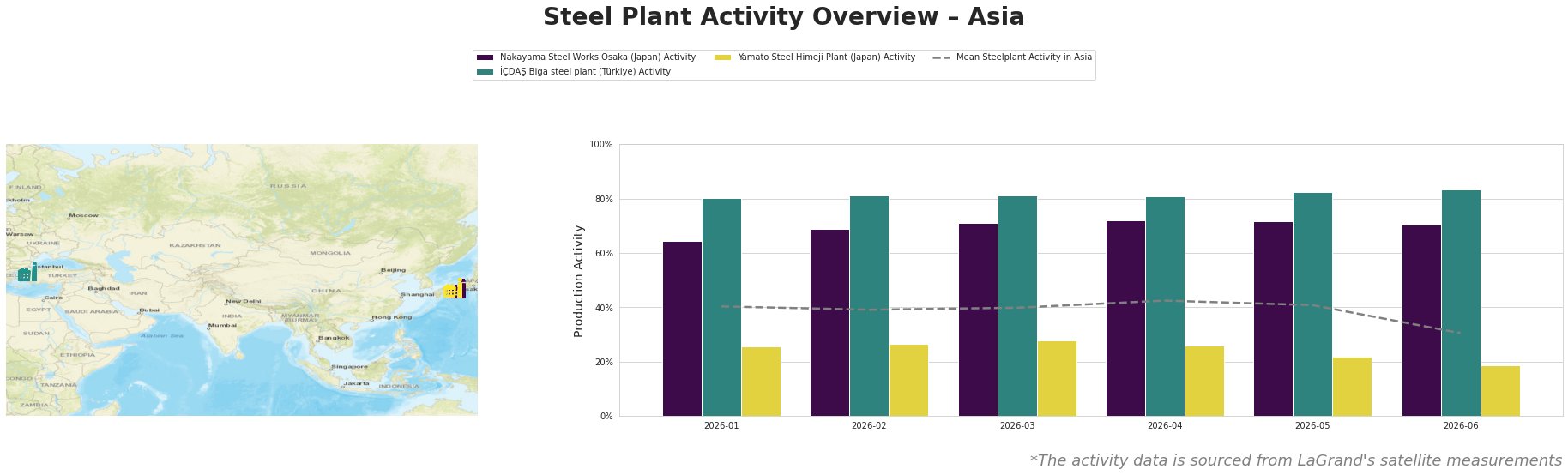
The activity at İÇDAŞ Biga, which peaked at 83% in June, contrasts sharply with a notable decline of 3% in Yamato Steel Himeji’s output, indicative of a more cautious output strategy despite the overall positive sentiment surrounding steel prices from the U.S.-Iran agreement. As stated in “U.S.-Iran Peace Deal to Boost Steel Industry Profits,” the easing of fuel inflation directly supports transportation and operational costs, which can provide a stabilizing effect for efficiency and output across the steel sector.
Nakayama Steel Works has shown stable activity levels (71% in June), maintaining its position amid broader market fluctuations. The performance trends do not directly connect with the news articles, indicating independent operational dynamics or potential sales agreements not affected by recent geopolitical changes.
İÇDAŞ Biga, with a substantial crude steel capacity of 2,500 tpy and a workforce of 6,045, continues to benefit from its diverse product range. The increase to 83% suggests robust demand, particularly for infrastructure projects amid the regional recovery. Yamato Steel, however, with its production emphasis on high-strength products like I-beams and channels, faces challenges as its activity dwindles to 19% despite the broader positive market vibe.
The potential implications of these activities are clear. Steel buyers should observe İÇDAŞ’s strong performance and may consider securing long-term contracts to capitalize on its growing capacity. Conversely, the declining output at Yamato indicates potential supply disruptions, suggesting that buyers may need to re-assess procurement strategies or diversify sources to mitigate risks as overall production trends remain mixed.
Steel procurement professionals are encouraged to navigate these shifting dynamics carefully, particularly focusing on İÇDAŞ Biga’s capabilities for long-term supply options while keeping an eye on Yamato Steel’s production status to avoid anticipated shortages. The effective monitoring of shipping routes established by the U.S.-Iran peace agreement remains integral, offering logistical efficiencies that could refine procurement strategies.