


From the Field to the Dashboard – Built by Experts, for Experts.
Discover What's Really Happening in the Steel Industry
Use the AI-powered search engine to analyze production activity, market trends, and news faster than ever before.
Try the Free AI Search EngineAsia Steel Market Report: Neutral Sentiment Amidst Global Tensions and Plant Activity Trends
Recent developments in Asia’s steel market reflect a neutral sentiment driven by global geopolitical tensions. Notably, Wall Street surges as Iran halts strikes and the US-Iran agreement to end hostilities ‘complete’ suggest potential stabilization; however, activity at regional steel plants remains inconsistent. Satellite observations indicate fluctuating operations, with changes not directly correlating with broader geopolitical events.
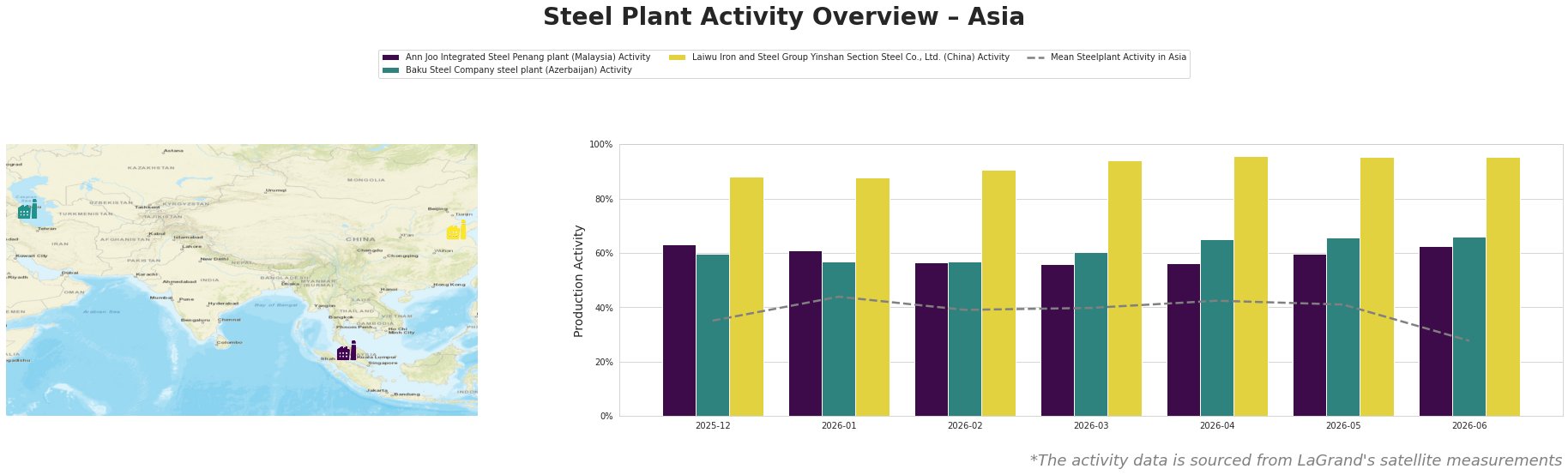
The mean steel plant activity in Asia dropped significantly from 41.0% in May to 28.0% in June, indicating a contraction in overall production capacity. Notably, Ann Joo’s activity remained relatively stable in the mid-60% range, while Baku Steel and Laiwu Steel fluctuated, with Baku performing at 66.0% and Laiwu at 95.0% in June. Laiwu Steel’s high activity level coincides with increasing demands in infrastructure projects, though without established links to specific news events.
The Ann Joo Integrated Steel Penang plant, known for its EAF technology, maintained a variable output, with activity last observed at 62.0% as of June 30. This trend appears unaffected by geopolitical developments such as those mentioned in Wall Street surges as Iran halts strikes, suggesting that local market conditions are primarily driving operational levels.
Conversely, the Baku Steel Company, deploying EAF technology, exhibited consistent performance peaking at 66.0% in June, indicative of regional stability in Eurasia, yet this has not blossomed into news-related activity coordination. As documented in the article Shipowners remain cautious on US-Iran deal announcement, uncertainty surrounding shipping routes may influence future procurement in the region.
Finally, Laiwu Iron and Steel Group Yinshan, operating a capacity of 5400 tons via integrated BF, reached an impressive activity level of 95.0% in June. This level of operation suggests robust domestic demand; however, current geopolitical tensions, underscored by IMO warns against strait of Hormuz transits, hint at potential supply chain vulnerabilities.
To mitigate potential supply disruptions, procurement professionals should prioritize sourcing from plants like Baku and Laiwu if stability persists. A careful monitoring of geopolitical events, combined with their impact on shipping logistics, remains essential for planning procurement strategies.