


From the Field to the Dashboard – Built by Experts, for Experts.
Discover What's Really Happening in the Steel Industry
Use the AI-powered search engine to analyze production activity, market trends, and news faster than ever before.
Try the Free AI Search EngineSteel Market Overview: China Faces Production Challenges Amid Neutral Sentiment
China has experienced significant changes in its steel output, driven by various economic dynamics. Recent articles, including China reduced steel output by 3.9% y/y in January–May and China’s crude steel output down 3.9 percent in January-May 2026, slight rebound in May, report a decline in steel production, totaling 415.5 million tonnes in the first five months of 2026. This aligns with satellite observations, which show a recent decrease in plant activity levels, suggesting ongoing challenges despite slight month-on-month rebounds.
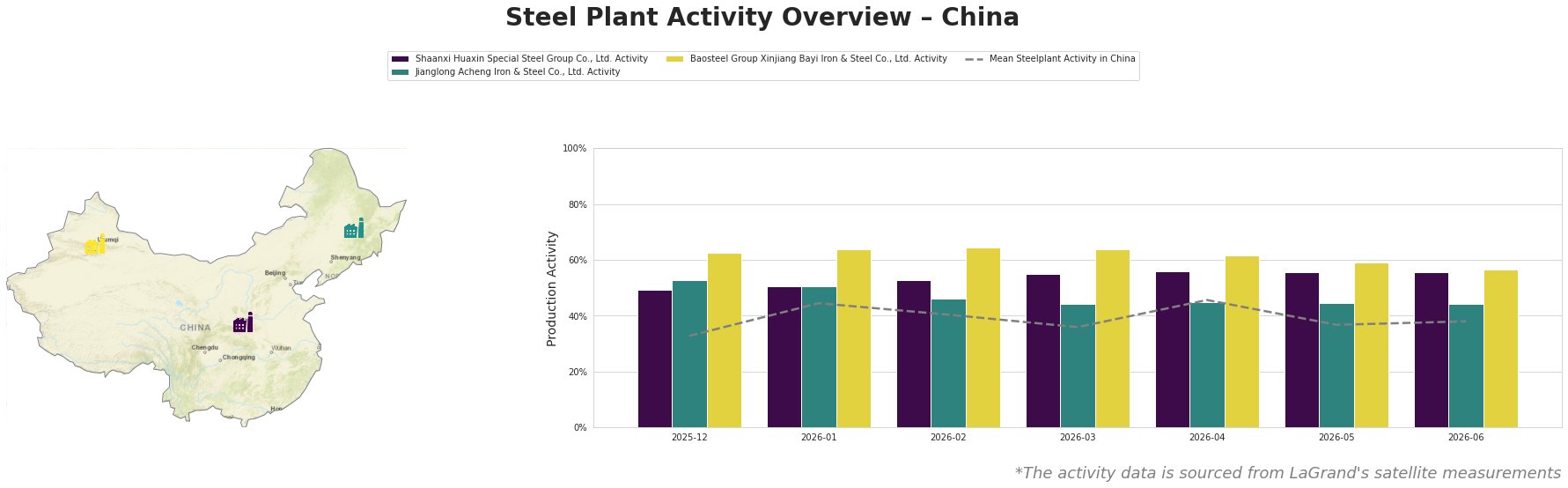
Shaanxi Huaxin Special Steel Group Co., Ltd.‘s activity remained stable at 56.0% throughout May, signaling resilience amidst the production decline, which could be impacted by the broader trends noted by Vale in their article Vale sees strong long-term iron ore demand despite China reaching steel production plateau, although no direct link to activity shifts was established.
Jianglong Acheng Iron & Steel Co., Ltd. reported a decrease to 45.0% in May, consistent with the nationwide output slowdown, and possibly reflecting reduced demand within the automotive sector, a key end-user identified in their product categories.
For Baosteel Group Xinjiang Bayi Iron & Steel Co., Ltd., its activity declined to 59.0% in May. The plant’s broad capacity for producing finished rolled products may position it favorably if domestic demand rebounds post the seasonal downturn highlighted in recent output statistics.
The evaluated market implications suggest potential supply disruptions, particularly for Jianglong Acheng due to their lower activity levels. Steel buyers should consider stocking up on rolled products from Shaanxi Huaxin and maintain a close watch on broader market dynamics to anticipate price movements. Given current trends, leveraging imports could be a prudent strategy, especially as other regions begin to drive demand for iron ore instead. Tailored procurement actions should focus on maintaining flexible supply arrangements to mitigate risks associated with fluctuating production levels in China.