


From the Field to the Dashboard – Built by Experts, for Experts.
Discover What's Really Happening in the Steel Industry
Use the AI-powered search engine to analyze production activity, market trends, and news faster than ever before.
Try the Free AI Search EngineChina Steel Market: Overcapacity Crisis Deepens Amid Falling Demand – Insights for Buyers
In China, the steel market sentiment is largely negative, stemming from significant overcapacity and declining demand. The OECD report, Global steel overcapacity deepens: OECD, highlights a projected overcapacity of 745 million tonnes by 2028, a situation exacerbated by Chinese exports amidst waning domestic demand. Satellite data reveals a concerning activity trend among key steel plants, paralleling the issues outlined in this report.
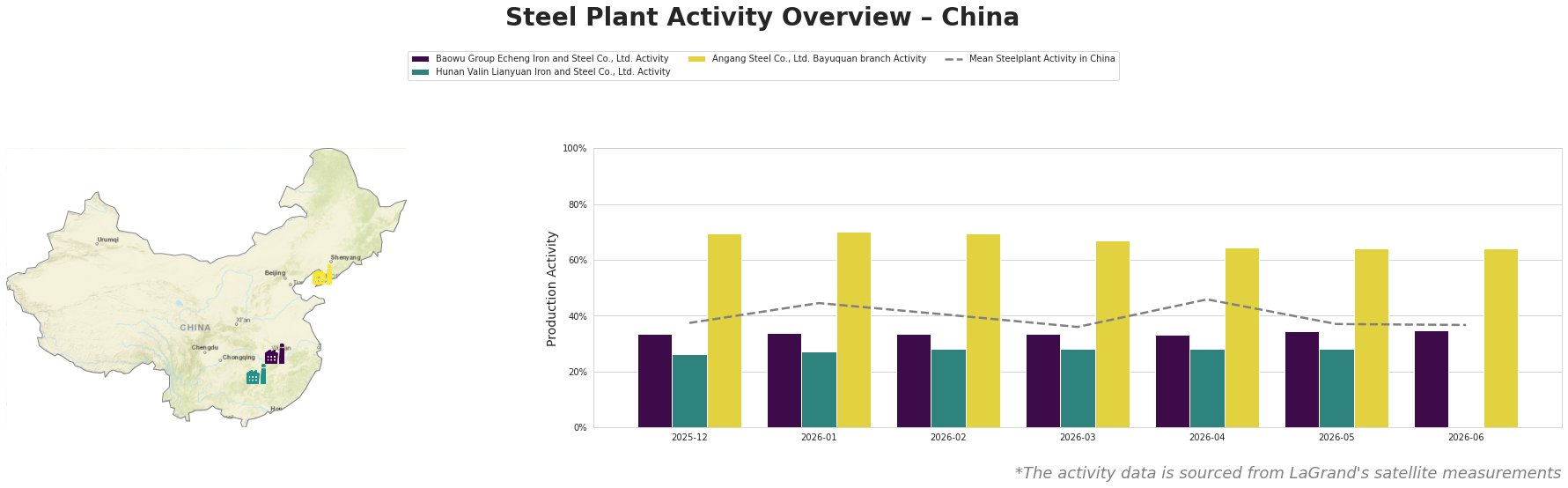
Baowu Group Echeng Iron and Steel Co., Ltd. in Hubei shows an overall decline in activity, averaging 34% with a notable drop to 33% by December 2025. Despite potential efficiency gains, the connection between this reduction and the OECD: Global steel excess capacity set to reach 745 million mt by 2028 article suggests an inability to optimize production due to market saturation.
Hunan Valin Lianyuan Iron and Steel Co., Ltd. has seen its activity stagnate around 26-28% throughout the observed period, peaking slightly at 28% in recent months. This aligns with the OECD: Global steel demand recovery to remain weak as excess capacity crisis deepens report indicating that confidence remains low among buyers, impacting production levels directly.
Angang Steel Co., Ltd. Bayuquan branch demonstrates higher stability, averaging 68.5% with a peak of 70% in January. This plant’s consistent performance may reflect demand from exports, as described in OECD: By 2028, the world’s excess steel production capacity will reach 745 million tons, although it still operates under the stringent conditions that plague the industry.
Potential supply disruptions are expected as the overall activity level across Chinese steel plants remains at 37%, with specific plants like Hunan Valin struggling to sustain operations. Steel buyers should consider adjusting procurement strategies in response to anticipated price drops driven by the ongoing oversupply crisis. Additionally, diversifying supply chains away from Chinese producers may mitigate risks associated with the concentrated pressure on domestic capacities as highlighted in the Anti-dumping measures on steel remained a common tool in 2025 – OECD report.
In conclusion, procurement actions need to be timely and strategic, considering both the observed low activity levels and the extensive capacities set to remain under-utilized in the Chinese steel market amid persistent global oversupply.