


From the Field to the Dashboard – Built by Experts, for Experts.
Discover What's Really Happening in the Steel Industry
Use the AI-powered search engine to analyze production activity, market trends, and news faster than ever before.
Try the Free AI Search EngineEuropean Steel Market Update: Positive Activity Trends Amid Renewed Political Discussions
Recent developments in Europe’s steel market show a very positive sentiment, supported by satellite-observed activity increases across key plants. The core issue revolves around the ongoing political discussions in Germany, highlighted in Friedrich Merz: „Wir müssen die sehr deutschen Reflexe hinter uns lassen“, sagt der Kanzler and Altkanzlerin: „Bin der Meinung, dass wir Klimaziele auch ohne Kernenergie erreichen können“, sagt Merkel. These discussions have not established a direct link to activity changes, yet they reflect an optimistic climate for energy transition supporting steel production.
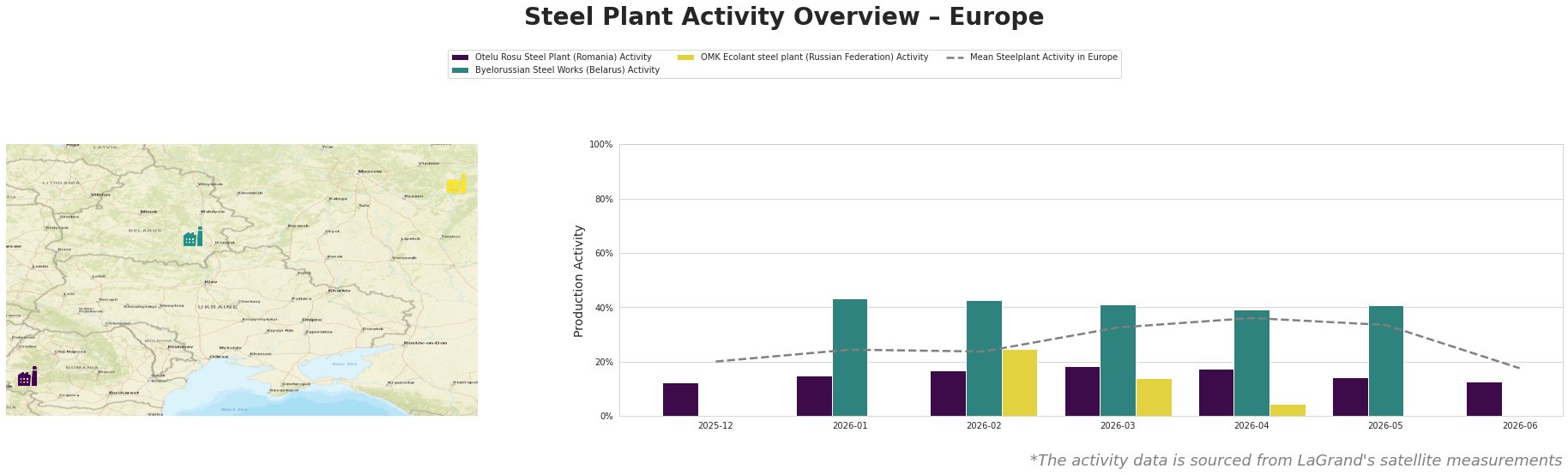
The Byelorussian Steel Works exhibited a peak activity of 43% in January and February 2026, significantly higher than the mean activity across Europe, indicating its robust operational performance. However, a steady decline occurred in activity, dropping to 41% in April and further declining thereafter, possibly linked to geopolitical tensions, although no direct connection with the news can be confirmed.
Otelu Rosu Steel Plant, observing lower activity levels, peaked at 17% in February 2026 but then fell to 12% by the end of June. Given its focus on electric arc furnace processes for producing semi-finished and finished rolled products, the decline raises concerns regarding capacity utilization, potentially influenced by an industry-wide shift towards sustainability highlighted in Merkel’s statements.
The OMK Ecolant Plant, initially operating at a 25% activity rate in February, faced significant operational challenges, plummeting to 1% by May, indicating possible supply shortages attributable to raw material constraints. Despite this, as the push towards renewable energy gains momentum in political discussions, future improvements in operational efficiencies may stabilize this plant’s output.
Potential disruptions are noted particularly for the OMK Ecolant Plant, where severe drops in activity may lead to procurement shortages. Steel buyers should prioritize sourcing from Byelorussian Steel Works while evaluating the possibility of integrating more diversified suppliers, especially for semi-finished products from Otelu Rosu, to mitigate risks associated with ongoing energy policy transitions in Germany.
To summarize, proactive engagement in supply diversification, with a focus on plants maintaining stable or growing activity levels, will be essential for navigating the evolving European steel market landscape.