


From the Field to the Dashboard – Built by Experts, for Experts.
Discover What's Really Happening in the Steel Industry
Use the AI-powered search engine to analyze production activity, market trends, and news faster than ever before.
Try the Free AI Search EngineEurope’s Steel Market Insights: Activity Trends in Ukraine Amid Recent Trade Measures
Recent developments in the European steel market reveal a neutral sentiment following a notable 11.7% year-on-year decline in Ukraine’s flat-rolled steel imports from January to April 2026, as reported in the article “Ukraine reduced imports of flat steel by 11.7% y/y in January–April.” This decline in imports mirrors decreased activity levels at key European steel plants, raising questions about future supply dynamics, particularly amid Ukraine’s anti-dumping investigation into coated steel imports from four countries highlighted in “Ukraine has launched an anti-dumping investigation into coated steel from four countries.”
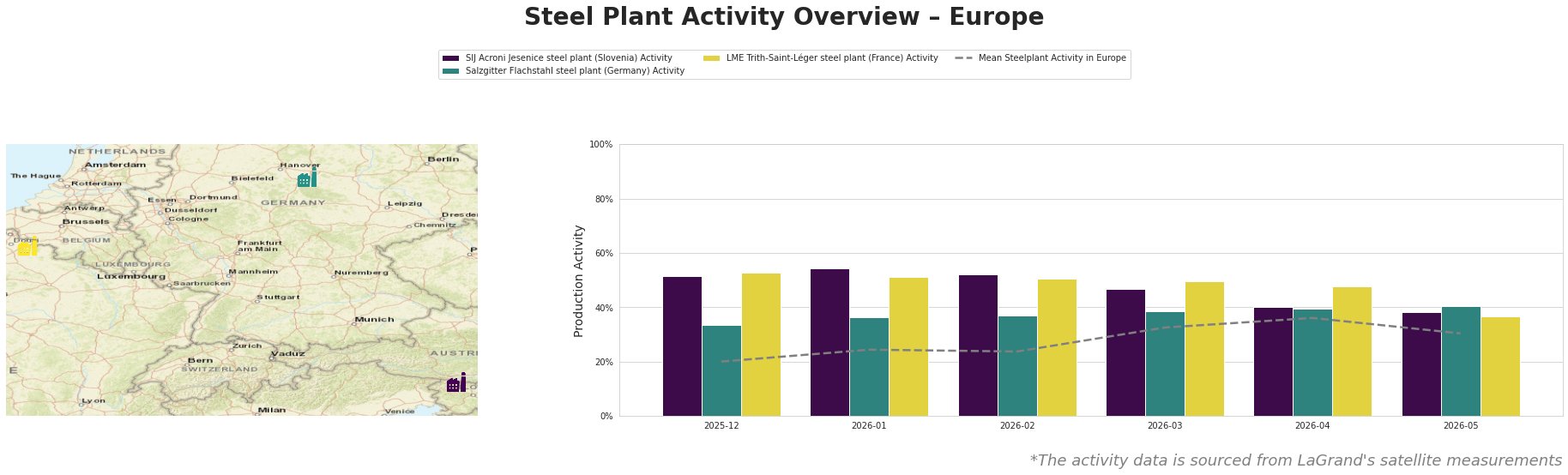
Activity at the SIJ Acroni Jesenice steel plant in Slovenia peaked at 54% in January 2026 but has seen a downward trend since, reaching 38% in May. This decline corresponds with the general market sentiment influenced by Ukraine’s reduced imports, as domestic demand dynamics are affected. The Salzgitter Flachstahl plant exhibited relatively stable operations, increasing slightly to 41% in May, as it prepares for a transition toward hydrogen-based steel, which is likely insulated from immediate import pressures. LME Trith-Saint-Léger likewise experienced a dip, reaching 37% in May but remained generally stable.
The observed lower activity levels at SIJ Acroni Jesenice increase the risk of supply disruptions for finished rolled products that are essential for building and infrastructure sectors. Similarly, Salzgitter’s shift towards lower CO2 emissions may enhance long-term sustainability but presents short-term procurement challenges as it pivots to greener technologies.
In terms of actionable strategies, steel buyers should monitor the developments surrounding the anti-dumping measures, as they may lead to tighter supply and higher prices for coated products, especially if these investigations impede imports from critical markets such as Turkey and South Korea. Immediate procurement efforts should focus on securing quantities from domestic sources or alternative suppliers less impacted by these trade actions. Buyers are advised to stay agile and responsive to further changes in plant operations, as significant deviations like those observed at the SIJ Acroni Jesenice plant may necessitate swift procurement tactics to mitigate risks.