


From the Field to the Dashboard – Built by Experts, for Experts.
Discover What's Really Happening in the Steel Industry
Use the AI-powered search engine to analyze production activity, market trends, and news faster than ever before.
Try the Free AI Search EngineJapan Steel Market Update: Activity Remains Steady Amid Falling Scrap Exports and Trade Investigations
Recent shifts in Japan’s steel sector have been marked by reduced scrap exports and the initiation of anti-dumping investigations. According to the article “Japan’s steel scrap exports down 9.9 percent in January-April 2026,” the decline was noted with total exports reaching 2.35 million metric tons, a drop of 9.9% year-on-year. This trend was observed while satellite activity showed consistent production levels across prominent steel plants. “Japan launched an anti-dumping investigation into flat steel imports from three countries“ indicates increased trade tensions, potentially impacting supply dynamics.
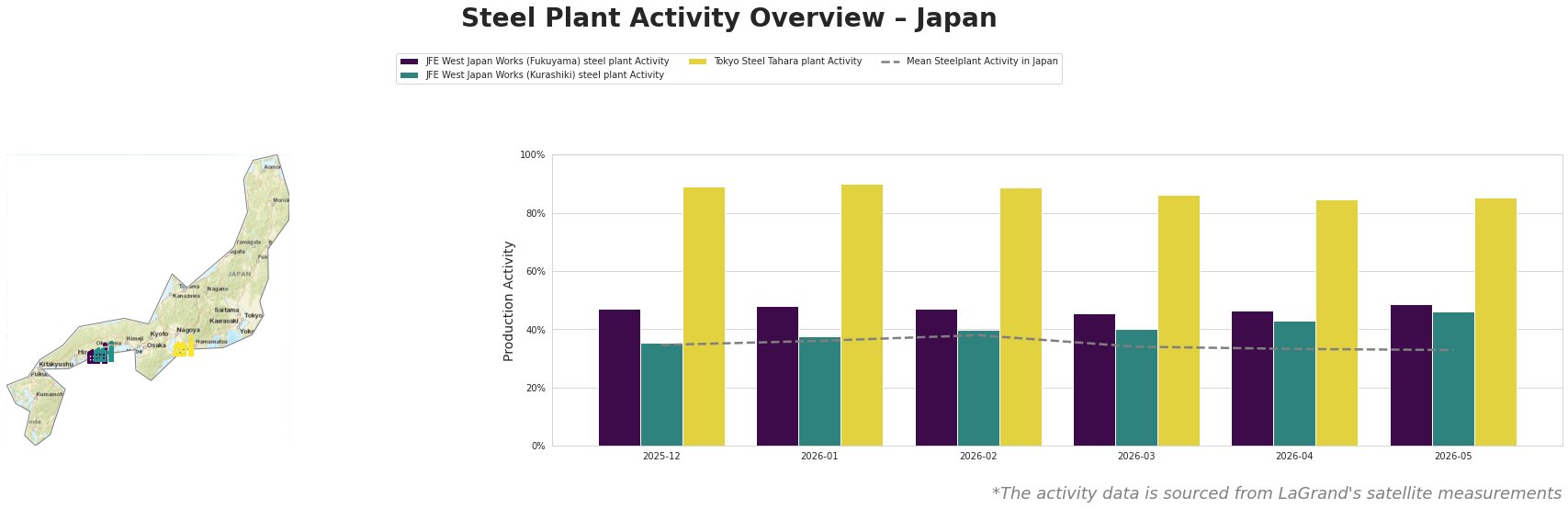
The activity levels at JFE West Japan Works (Fukuyama) have been relatively stable, with a peak of 49.0% noted in May, aligning with its role in producing seamless steel products for multiple sectors. The Kurashiki plant exhibited marginal fluctuations but remained close to the average activity levels, possibly reflecting the demand trends mentioned in the news articles. The Tokyo Steel Tahara plant demonstrated higher stability, maintaining consistently high activity levels throughout the observed period, critical for its output of hot-rolled and steel sheet products.
The investigation into flat steel imports, as highlighted in “Japan has taken up cheap steel imports: the investigation will last a year,” signals potential shifts in domestic supply chains and pricing, warranting close monitoring by buyers and analysts. Increased scrutiny on imports from China, South Korea, and Taiwan may create a window for domestic producers to strengthen their market share, especially if prices for imported products rise due to trade measures.
Given this backdrop, procurement teams should consider diversifying their supply sources away from imports, especially for flat-rolled products that may see price hikes. Additionally, tracking production stability at domestic plants, particularly in light of reduced export metrics and potential supply chain disruptions, is recommended to optimize inventory strategies.
In conclusion, while market sentiment remains neutral, the evolving dynamics of export levels and domestic production capabilities suggest a cautious approach in procurement strategies, leveraging current production stability while anticipating potential shifts in the pricing landscape.