


From the Field to the Dashboard – Built by Experts, for Experts.
Discover What's Really Happening in the Steel Industry
Use the AI-powered search engine to analyze production activity, market trends, and news faster than ever before.
Try the Free AI Search EngineEuropean Steel Market Report: German Production Surges While Activity Levels Stabilize
In Europe, particularly Germany, steel production has shown signs of recovery, with a notable 9.5% year-on-year increase in April 2026. This change is highlighted in the articles titled “Germany increased steel production by 9.5% y/y in April“ and “German crude steel output up 9.1 percent in Jan-Apr 2026,” revealing distinct improvements in output despite consecutive month-on-month declines. Satellite-observed data indicates trends in various steel plants, thus reflecting the broader market dynamics.
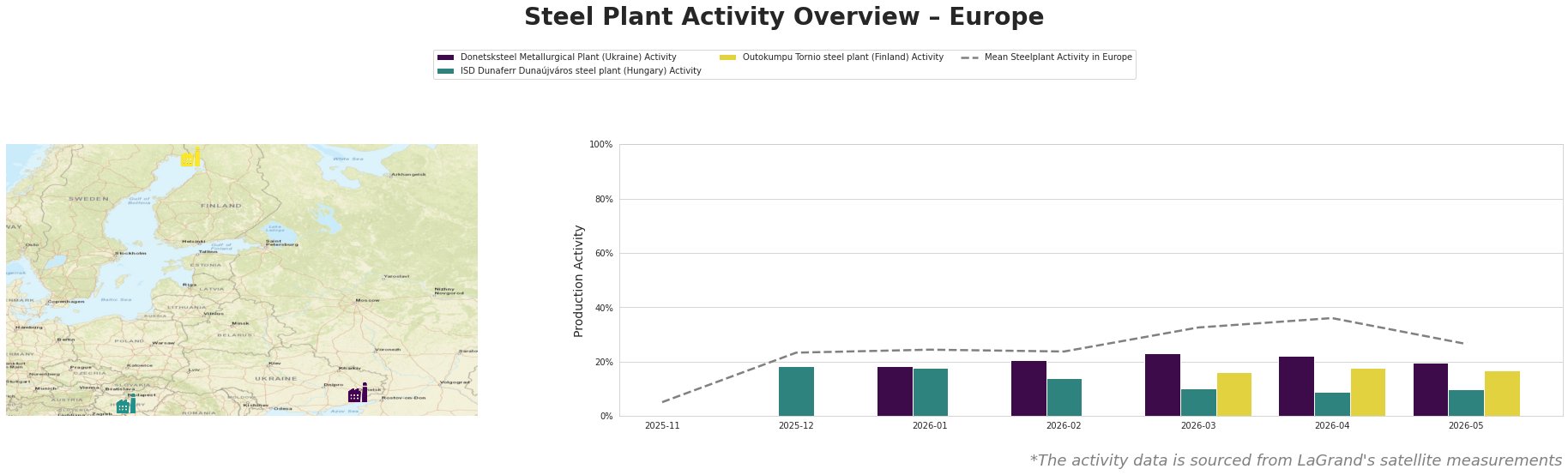
Recent activity data shows that the mean steel plant activity in Europe reached a peak of 36% in April 2026 but dropped to 27% in May. The Donetsksteel Metallurgical Plant’s activity was stable at 20% in May, a slight decrease from April, while ISD Dunaferr’s activity fell to 10% in May, revealing a trend of declining performance. Outokumpu Tornio observed stable output around 17-18%, indicating resilience amid fluctuating mean activity levels.
Donetsksteel Metallurgical Plant continues to operate well below capacity, with its production linked to challenging local conditions, but recent data do not suggest any direct correlation to the German production increases. ISD Dunaferr Dunaújváros has seen notable declines, with a drop from 9% in April to 10% in May, indicating potential local issues affecting output which have not been directly addressed in the news articles. Outokumpu Tornio, while stable, also shows no direct link to the German production trends as its operations remain primarily steady despite the market’s mixed signals.
The potential risk for supply disruptions, particularly from ISD Dunaferr due to its significant activity drop, alongside Donetsksteel’s historically low production capabilities, suggests procurement strategies need to focus on sourcing from more stable suppliers to mitigate risks. Steel buyers should consider increasing orders from the German market, where output is consistently rising, as highlighted in the news, and align procurement timelines with observed recovery patterns noted in the relevant articles.