


From the Field to the Dashboard – Built by Experts, for Experts.
Discover What's Really Happening in the Steel Industry
Use the AI-powered search engine to analyze production activity, market trends, and news faster than ever before.
Try the Free AI Search EnginePositive Steel Market Trends in Asia: Activity on the Rise Amid Production Adjustments
In Asia, the steel market exhibits a positive sentiment despite recent production adjustments, particularly in China. Notably, “China reduced iron ore production by 1% y/y in January–April“ highlights the shift in output as China navigates its production landscape. The ensuing activity levels observed in steel plants correlate with this news, suggesting adjustments in the supply chain that buyers should monitor closely.
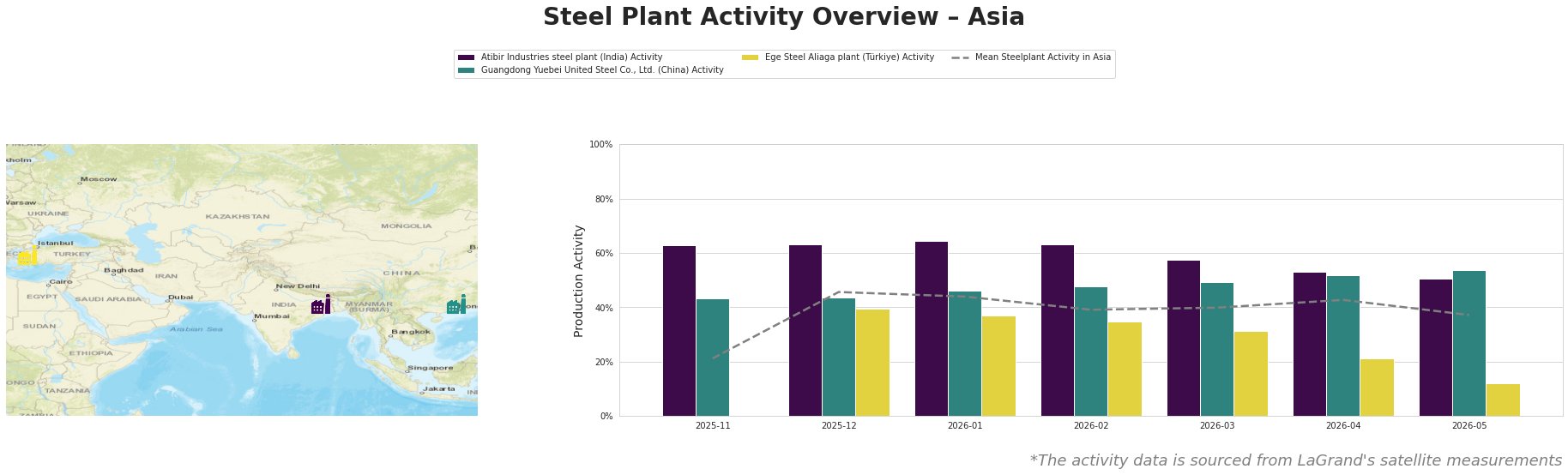
The average activity across observed steel plants in Asia exhibits recent peaks and drops in activity levels. The significant decrease observed in May (37.0%) indicates market adjustments that align with “Global steel production fell by 4.1% m/m in April“, signaling a production slowdown. This drop is coupled with specific operational patterns at Guangdong Yuebei United Steel Co., Ltd., whose activity rose to 54.0% in May following an initial April dip but continues to face fluctuations aligning with external demand pressures.
Atibir Industries in India maintains a commendable activity level between 63.0% to 64.0%, relatively stable compared to other plants, reflecting resilience in production capacity against a backdrop of fluctuating market conditions. In contrast, Ege Steel Aliaga’s performance sharply dropped to 12.0% by May, suggesting potential operational challenges that may arise due to decreased demand or supply chain issues, though no direct connection can be made to the recent news.
Atibir Industries operates an integrated steel plant utilizing BOF technology with a crude steel production capacity of 600 tons. The observed activity level of 50.0% in May remains strong, supported potentially by continued internal demand or effective stockpiling strategies. This is particularly relevant amid reports of fluctuating iron ore import demands, as seen in “China’s rebar output down 13.5 percent in January-April 2026“, which may influence regional supply dynamics.
Guangdong Yuebei United Steel Co. saw activity stabilize around 54.0% in May, indicating responsiveness to market conditions, despite facing a 4.1% production decline. The company relies heavily on the local construction market for rebar production, mirroring adjustments noted in “China’s rebar output down 13.5 percent in January-April 2026” that suggest potential for operational expansion if demand rebounds.
Ege Steel Aliaga, emphasizing EAF technology for semi-finished and finished rolled products, has shown a concerning drop in activity as demand wanes. The decline to 12.0% in May may foreshadow potential supply disruptions that buyers should consider when planning procurement strategies.
In summary, steel buyers are advised to closely monitor these shifting production levels across key facilities and consider securing supply contracts proactively, especially from resilient producers like Atibir Industries. Furthermore, analysts should anticipate potential supply disruptions from Ege Steel Aliaga and adjust forecasting models to account for external market influences, particularly related to iron ore imports and shifting global demand patterns as highlighted in the provided news articles.