


From the Field to the Dashboard – Built by Experts, for Experts.
Discover What's Really Happening in the Steel Industry
Use the AI-powered search engine to analyze production activity, market trends, and news faster than ever before.
Try the Free AI Search EngineSteel Market Activity in Asia: Stable Yet Cautious Amid Geopolitical Tensions
Recent developments in Asia showcase a complex blend of diplomatic negotiations and fluctuating steel plant activities. The sentiment around the region remains Neutral. Notably, the articles “Trump-Xi’s China summit is a defining test for America in the new Cold War” and “Trump leaves China with no agreement on thorny issues, but cites ‘very good’ talks with Xi” highlight the ongoing geopolitical tensions influencing market dynamics, notably around Taiwan, yet their direct impact on steel plant activities remains unclear.
Measured Activity Overview
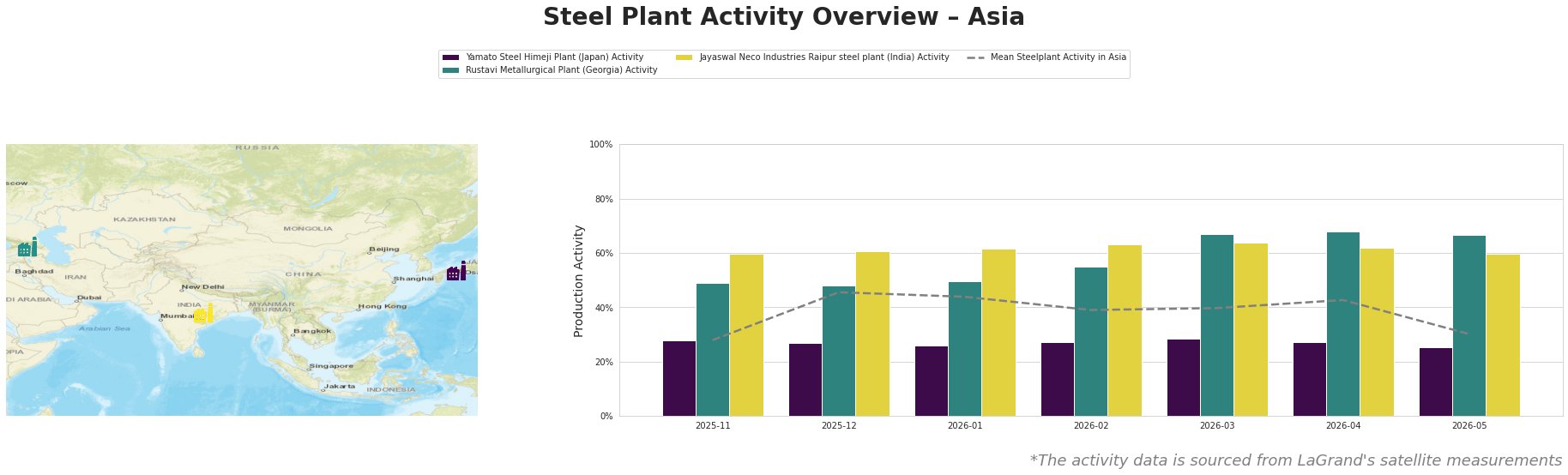
The activity across steel plants has shown fluctuations with a significant peak at 68.0% for the Rustavi Metallurgical Plant in April 2026, indicating strong operational periods. However, the Yamato Steel Himeji Plant has declined to a low of 25.0% in May 2026, indicating a more cautious stance contrary to the plant’s previous performance throughout the earlier months. In comparison, the overall mean activity level has oscillated from a low of 28.0% to a peak of 46.0%, exemplifying a trend of variability within the market.
Plant Information
The Yamato Steel Himeji Plant, located in Japan, operates with a capacity of 1,495 tonnes via Electric Arc Furnace (EAF) technology, focusing primarily on semi-finished and finished rolled products. Recently, it experienced a drop to 25.0% activity in May 2026, down from peaks in the previous months. This decline may reflect strategic conservative decision-making amidst evolving geopolitical scenarios as articulated in “Trump-Xi’s China summit is a defining test for America in the new Cold War.”
In contrast, the Rustavi Metallurgical Plant in Georgia has sustained a robust output with up to 68.0%, adapting to market demands effectively. Its integrated production process combines Blast Furnace (BF) and EAF systems, capable of producing various steel forms from pig iron to finished rolled products. Activity stabilization around 67.0% in May highlights resilience despite the uncertain environment described in relevant news, though no direct correlation with events was established.
The Jayaswal Neco Industries Raipur steel plant in India mirrors a steady operational capacity across product categories. Its activity peaked at 63.0% in February but receded to 60.0% in May. This comparatively stable performance suggests a consistent demand for its products, although the geopolitical landscape raises considerations for potential supply chain impacts, especially given references to regional stability in “Chill coming from Trump’s summit with Xi is proof of a new Cold War with China.”
Evaluated Market Implications
Steel procurement professionals should be aware of the potential for localized supply disruptions especially related to ongoing geopolitical tensions affecting Taiwan—an economically significant region for semiconductor production and consequently impacting steel demand. Given that no new tariffs were agreed upon during Trump’s visit to China, the immediate risks may be mitigated, encouraging stable procurement patterns.
Recommendations:
– Yamato Steel Himeji Plant: Given the reduced activity, it is prudent to evaluate alternatives or secure secondary suppliers to ensure material availability.
– Rustavi Metallurgical Plant: Buyers may consider short-term increases in procurement to capitalize on the plant’s high operational efficiency.
– Jayaswal Neco Industries Raipur Steel Plant: Firms in need of regular supplies should negotiate long-term contracts to shield against potential regional disruptions linked to volatility in geopolitical relationships.
Such strategies would help navigate a nuanced and dynamic market landscape for steel across Asia.