


From the Field to the Dashboard – Built by Experts, for Experts.
Discover What's Really Happening in the Steel Industry
Use the AI-powered search engine to analyze production activity, market trends, and news faster than ever before.
Try the Free AI Search EnginePositive Outlook for Europe’s Steel Market Amid Strategic Trade Discussions
Recent developments in Europe demonstrate a stabilizing sentiment in the steel market. The article “Europe needs an open steel market with the UK – Unesid“ emphasizes the urgency of maintaining open trade relations with the UK to address industry challenges. This aligns with witnessed shifts in activity levels at significant steel plants across Europe, particularly as these discussions evolve. Notably, “BCC warns that changing steel quotas in the UK could disrupt supply chains“ highlights potential disruptions from planned quota reductions, encouraging proactive measures among steel buyers.
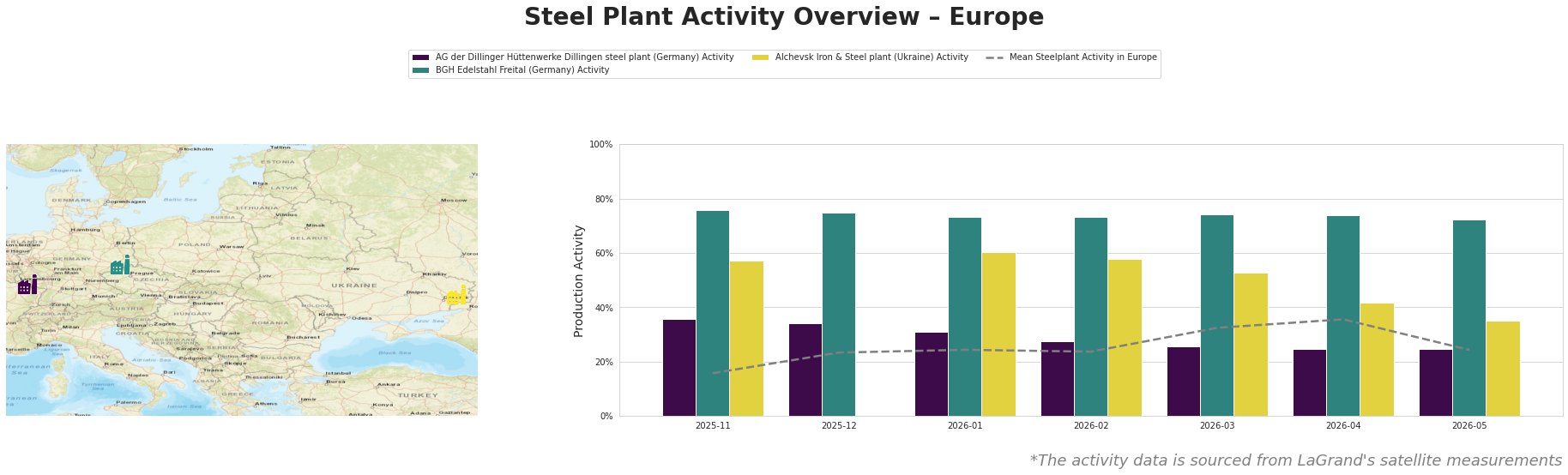
The AG der Dillinger Hüttenwerke Dillingen steel plant exhibited declining activity levels, recorded at 25.0% in May from a peak of 36.0% in November 2025. This decrease coincides with increased concerns about potential supply chain disruptions raised in the BCC article. The plant, utilizing integrated production methods, focuses on a wide range of semi-finished and finished rolled products across various sectors, from automotive to construction.
In contrast, BGH Edelstahl Freital, while more stable, saw a drop from 76.0% in November 2025 to 72.0% in May 2026. With a focus on stainless and tool steels, this plant is critical to sectors requiring high-performance materials. The decline reflects broader market hesitance surrounding the UK’s impending trade restrictions.
The Alchevsk Iron & Steel plant also experienced a downturn, landing at 35.0% as of May, down from 57.0% in November. This plant’s integrated processes produce vital semi-finished products, underscoring its strategic importance amid fluctuating demand dynamics potentially exacerbated by UK tariff changes.
The strategic dialogues indicated in “UNESID urges EU to maintain open and balanced steel trade with UK“ reinforce the importance of adaptive procurement strategies. As negotiations unfold regarding import quotas, it is imperative for buyers to actively monitor these developments and consider sourcing adjustments. The urgency to secure open trade lines, as highlighted in these articles, suggests that procurement managers should prioritize building resilient supply chains and relationships with both the EU and the UK.
Recommendations:
- Prioritize suppliers aligned with EU standards: Assess relationships with producers supporting open trade initiatives.
- Diversify supply sources: Given the uncertainty around UK import footings, consider alternative suppliers, specifically those with robust logistics capabilities.
- Engage in proactive dialogue: Maintain open lines with both EU and UK vendors to anticipate changes and adjust procurement strategies accordingly.
These actions are essential as the market navigates potential disruptions tied to evolving trade policies influencing steel availability and pricing dynamics.