


From the Field to the Dashboard – Built by Experts, for Experts.
Discover What's Really Happening in the Steel Industry
Use the AI-powered search engine to analyze production activity, market trends, and news faster than ever before.
Try the Free AI Search EngineEuropean Steel Market Report: Positive Trends Amid UK Nationalization of British Steel
Recent developments in Europe, particularly stemming from the UK, indicate a very positive outlook for the steel market. The imminent UK prepares to fully nationalize British Steel and British Steel nationalisation proceeds as Jingye talks fail reflect a governmental commitment to maintaining steel production capacity while safeguarding jobs at the Scunthorpe plant. This initiative coincides with upticks in observed satellite activity levels, specifically at the AG der Dillinger Hüttenwerke Dillingen steel plant, which has reported stable operation amidst broader European trends.
Measured Activity Overview
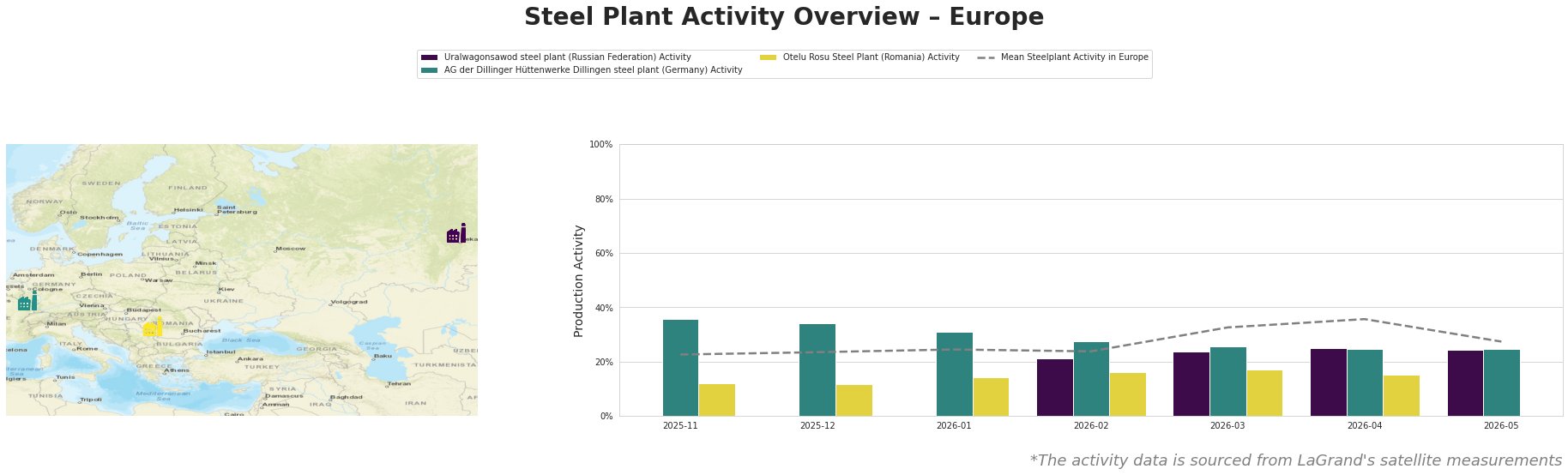
Overall, the mean activity across observed European steel plants demonstrated significant fluctuations, with notable peaks in March 2026 at 33.0% activity and April 2026 reaching 36.0%. The AG der Dillinger Hüttenwerke Dillingen steel plant has consistently exhibited activity levels around 34.0% to 36.0%, significantly above the mean activity readings. In contrast, the Uralwagonsawod steel plant remains inactive, showcasing a clear deviation, yet lacking a direct connection to the news developments regarding British Steel.
Plant Narratives
The AG der Dillinger Hüttenwerke Dillingen steel plant, strategically positioned in Saarland, has maintained a steady operational status with activity peaking at 36.0% in late November. Its integrated steelmaking process is crucial for sectors such as automotive and infrastructure. Despite some mid-term reductions to 25.0% in March and April, it is expected the renewed focus on national scrap and steel production consolidation will support its operations.
In contrast, the Uralwagonsawod steel plant has had no recorded activity, reflecting potential operational or market-related challenges. However, it is crucial to highlight that no direct connections are established between this stagnation and the UK government actions as outlined in the relevant news articles.
Meanwhile, the Otelu Rosu Steel Plant has reported modest activity, ranging between 12.0% to 17.0%, indicative of stable demand but low production capacity utilization. This steady trend paired with shifts in the UK market might offer opportunities for alternative sourcing, especially in specialized steel products.
Evaluated Market Implications
The nationalization of British Steel aims to bolster domestic production capabilities, potentially creating a more favorable trading environment for imported steel from plants like AG der Dillinger Hüttenwerke. However, the Otelu Rosu Steel Plant, facing stagnant activity rates, might present procurement challenges for buyers focusing on corrosion-resistant or specialty structural steels.
Given this context:
- Procurement recommendations: Steel buyers should consider securing orders from the AG der Dillinger Hüttenwerke Dillingen plant, given its robust activity levels and strategic output aligned with increased domestic needs under UK governmental initiatives.
- Monitor closely any shifts in pricing and availability, as heightened interest in UK steel assets may induce supply constraints in the broader EU sourcing landscape.
Overall, the European steel market is positioned favorably, particularly for entities willing to adapt procurement strategies in light of emerging developments from the UK nationalization efforts.