


From the Field to the Dashboard – Built by Experts, for Experts.
Discover What's Really Happening in the Steel Industry
Use the AI-powered search engine to analyze production activity, market trends, and news faster than ever before.
Try the Free AI Search EngineNegative Sentiment: European Steel Market Faces Challenges from US Tariffs and Plant Activity Declines
Europe’s steel market sentiment is currently negative, primarily driven by economic vulnerabilities highlighted in recent developments. The introduction of potential tariffs, as reported in “Donald Trump: Neue Zolldrohung gegen EU im Fokus“, raises concerns about the economic stability of the region, particularly affecting industries reliant on export, including automotive manufacturers that drive steel demand. The association of these tariffs with a likely recession was pointed out in “Liveblog Bundespolitik: Stegner begrüßt Trumps Entscheidung, US-Raketen nicht in Deutschland zu stationieren”. Correspondingly, a notable decline in activity levels in major steel plants, as seen in satellite data, reflects these broader economic tensions.
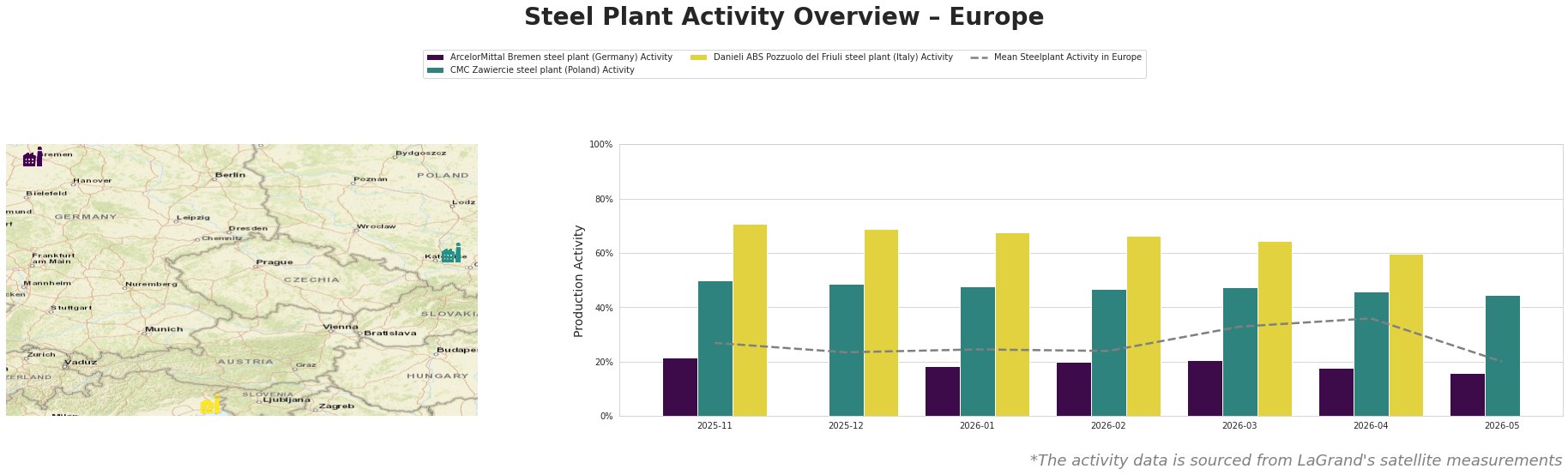
The ArcelorMittal Bremen steel plant in Germany has seen a drastic reduction in activity, peaking at 36% in April 2026 and dropping to 16% by May. This decline may be reflected in the overall negative sentiment surrounding U.S. tariffs, impacting demand in the automotive sector, a key user of the plant’s output, primarily hot and cold rolled coils.
CMC Zawiercie showed a steady decrease, falling from 50% in November to 45% by May 2026. This consistent decline aligns with the broader market’s reaction to the news surrounding potential U.S. tariffs that threaten European manufacturing sectors reliant on steel.
Finally, the Danieli ABS Pozzuolo del Friuli steel plant has maintained relatively high activity levels, starting at 71% in November and gradually decreasing to 60% in April before failing to report in May. Although no specific link can be established between the decrease in activity and the tariff discussions, its position as a significant player in the Italian market suggests potential disruptions are forthcoming.
Acknowledging potential supply disruptions, steel buyers should prepare for procurement challenges, especially regarding products from ArcelorMittal Bremen and CMC Zawiercie. Given the current geopolitical climate and the evident drop in manufacturing activity, it would be prudent to secure contracts early and explore alternative suppliers or regions less impacted by the U.S. tariffs.