


From the Field to the Dashboard – Built by Experts, for Experts.
Discover What's Really Happening in the Steel Industry
Use the AI-powered search engine to analyze production activity, market trends, and news faster than ever before.
Try the Free AI Search EngineEurope Steel Market Update: Plant Activity Dips Amid New Trade Measures
Recent developments in the European steel market reveal a Neutral sentiment influenced heavily by protective trade measures introduced by both the EU and the UK. The articles EU announces new steel import quotas and changes in their application and UK trade measures will lead to disruptions in the supply of stainless steel bars indicate that new tariff quotas are reshaping the landscape. Notably, this has not directly correlated with satellite-observed activity levels at major steel plants.
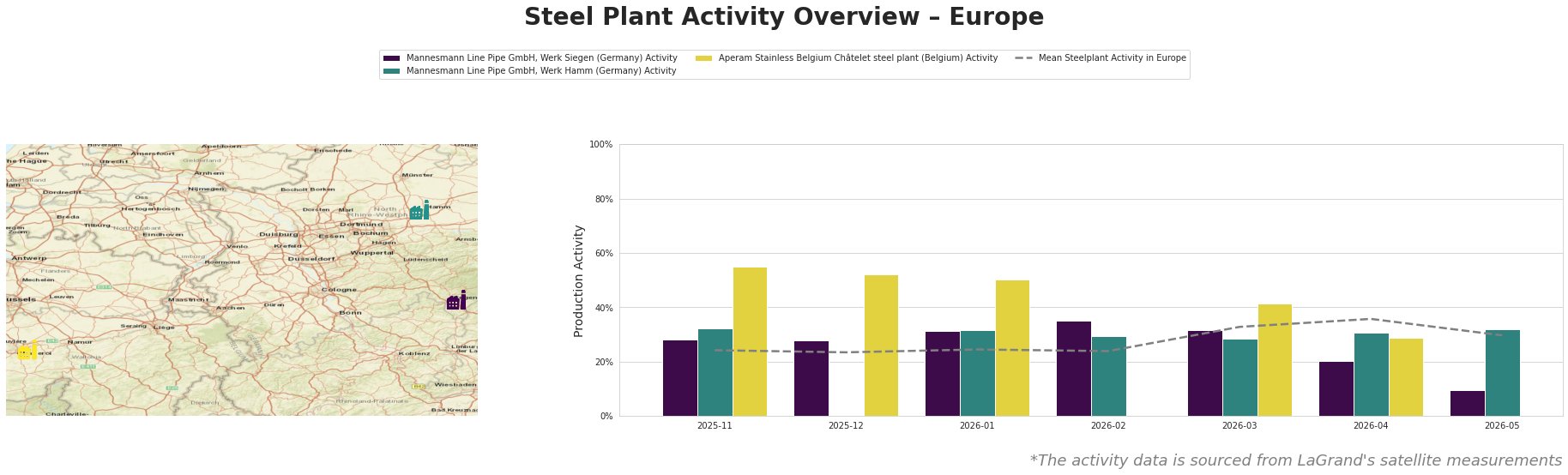
The Mannesmann Line Pipe GmbH, Werk Siegen experienced a significant drop to 9% activity in May 2026, compared to a mean steel plant activity of 30%. This might link to heightened uncertainty caused by the UK’s protective trade measures for stainless steel, complicating market dynamics and reducing demand for associated products. The facility primarily utilizes Electric Arc Furnace (EAF) technology, focusing on pipe manufacturing, which may face adverse effects due to import restrictions.
At Mannesmann Line Pipe GmbH, Werk Hamm, activity remained steady around 32% as of May 2026. However, no direct connection with the cited news articles could be established. The plant’s output remains focused on pipe products, similar to its counterpart.
Contrasting significantly, the Aperam Stainless Belgium Châtelet steel plant averaged around 41% activity levels, down from 55% in November 2025, which indicates a general decline yet is still above the mean activity levels for other facilities. As a significant producer of stainless steel and other processed products, it might be influenced by future changes stemming from the EU’s new import regulations looking to counteract global overcapacity, although specific links remain unproven.
Given this fluid environment, steel buyers should prioritize sourcing from suppliers with reliable supply chains amid rising import tariffs and quotas. It is particularly wise to engage with Aperam regarding stainless steel, monitoring their capacity adjustments and responsiveness to import tariffs. Monitoring changes will help in mitigating potential supply disruptions that could arise from the implementation of new trade measures, as highlighted in WTO Committee reviews steel safeguards.
In summary, while some plants have stabilized, the overarching environment driven by policy changes suggests that procurement strategies should be adapted promptly to maintain supply chain integrity.