


From the Field to the Dashboard – Built by Experts, for Experts.
Discover What's Really Happening in the Steel Industry
Use the AI-powered search engine to analyze production activity, market trends, and news faster than ever before.
Try the Free AI Search EnginePositive Steel Market Trends in Asia: Key Insights from Recent Activity
Recent activity in the Asian steel market indicates a positive trajectory, particularly highlighted by the articles “Japan’s steel exports down 10.1 percent in Jan-Mar 2026” and “Baosteel produced 13.2 million tons of steel in Q1”. Observed satellite data suggests increased operational activity in selected plants, aligning with notable increases in product output despite pressures in export figures.
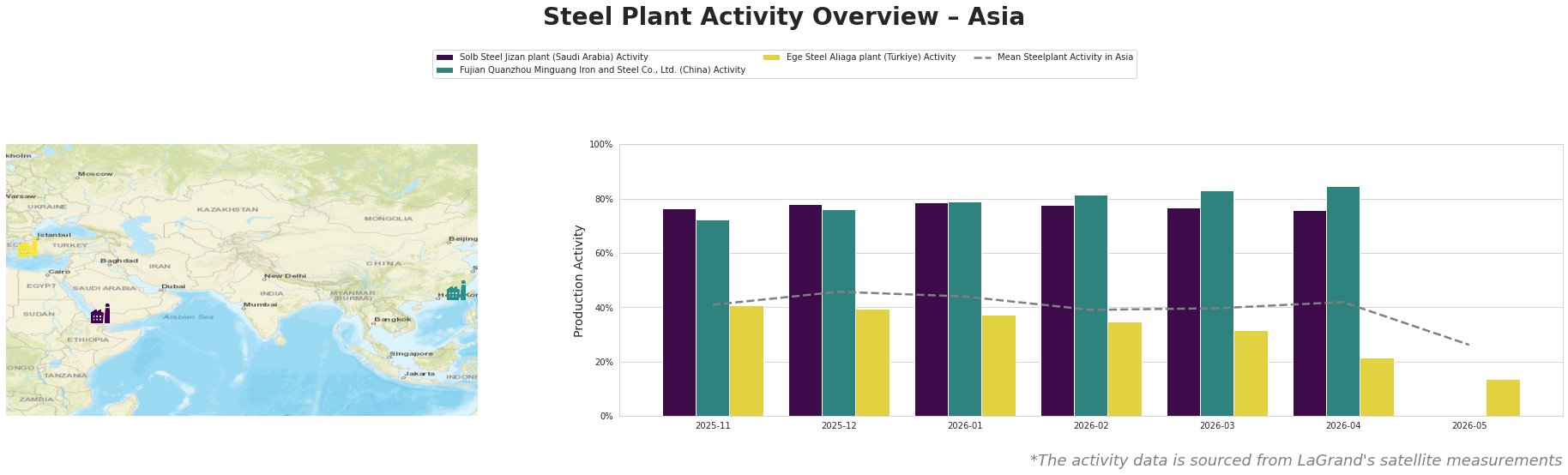
The productivity at the Fujian Quanzhou Minguang Iron and Steel Co., Ltd. exhibited a peak with an 83% activity level in March 2026 but saw a decline to 85% in April, correlating with the pressure reported in “Baosteel produced 13.2 million tons of steel in Q1”. This trend reflects challenges due to geopolitical factors although increasing output is observed in other segments. Solb Steel Jizan has maintained high activity levels, reaching up to 79% in January 2026. The activity levels notably exceeded the mean for the region, indicating a strong operational capacity.
Conversely, the Ege Steel Aliaga plant experienced a significant drop, reaching only 21% in April compared to 32% in March, indicating potential operational or demand-related challenges. This decline might be substantiated by the broader market trends highlighted in the news articles, though no direct correlations with specific articles were established for the Ege Steel Aliaga plant.
With decreasing inventory levels for main finished steel products in China as reported in “Stocks of main finished steel products in China down 2% in mid-April 2026”, there is a tapering demand that may indicate a peak season realization. This aligns positively for procurement timelines, especially for buyers able to anticipate restocking needs.
Given these observations:
– For procurement professionals, now is a strategic time to capitalize on current activity levels before anticipated supply fluctuations manifest, especially in regions seeing high activity like the Fujian plant.
– Those dealing with Ege Steel should explore negotiations or alternative sourcing as its recent sharp declines underscore vulnerabilities in output.
– Attention should be focused on Baosteel and its export strategies amid geopolitical tensions, while staying agile to shifts that may follow in ancillary markets due to fluctuating production rates.
These insights guide informed decision-making amidst evolving market conditions, emphasizing the necessity to remain vigilant in procurement strategies as activity levels consolidate and adjust in the Asian steel landscape.