


From the Field to the Dashboard – Built by Experts, for Experts.
Discover What's Really Happening in the Steel Industry
Use the AI-powered search engine to analyze production activity, market trends, and news faster than ever before.
Try the Free AI Search EnginePositive Outlook for European Steel Market Amid Restructuring Activities
Recent developments in the European steel industry indicate a positive market sentiment, particularly influenced by restructuring efforts at Thyssenkrupp. Articles such as “Thyssenkrupp and Jindal have called off talks regarding the sale of the steel division” and “Thyssenkrupp and Jindal Steel International suspend share talks” shed light on the company’s strategic adjustments and affirm an improving outlook as CEO Miguel López highlights. Satellite data reveal notable activity variations in key steel plants, notably following these ongoing discussions.
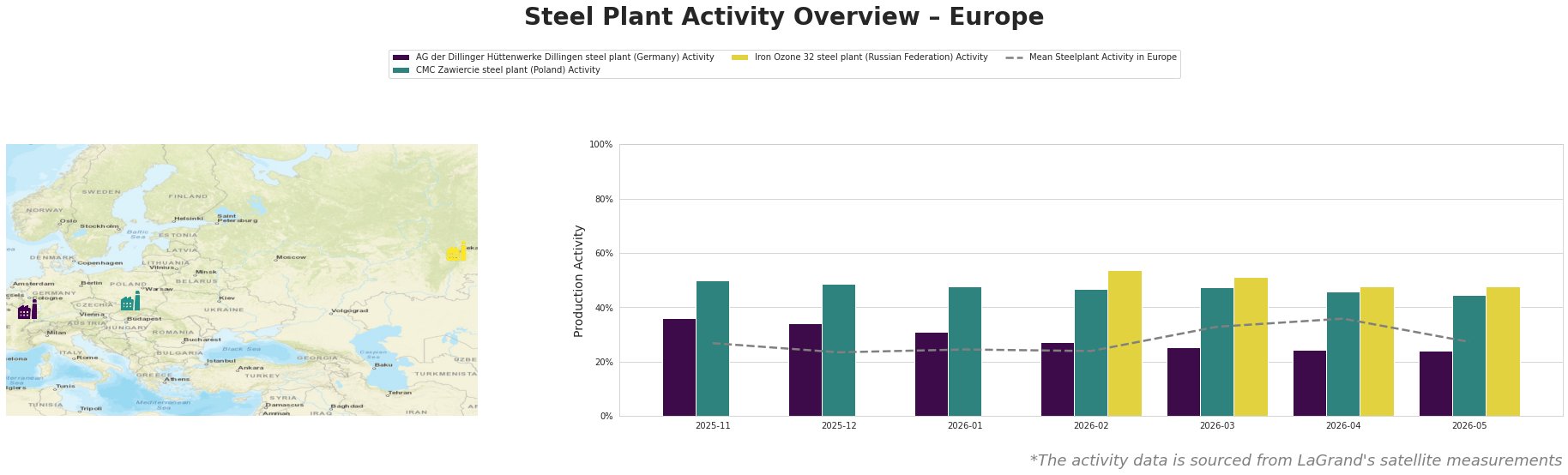
The AG der Dillinger Hüttenwerke Dillingen plant saw activity fluctuations peaking at 36% in November before declining to 24% by May. This trend aligns with ongoing strategic evaluations within Thyssenkrupp as noted in the article “Thyssenkrupp and Jindal have called off talks regarding the sale of the steel division,” reflecting potential internal restructuring impacts. By contrast, CMC Zawiercie maintained relatively stable activity levels between 45% and 50%, suggesting resilience amid broader market changes.
The Iron Ozone 32 plant demonstrated a notable peak at 54% in February, though the lack of recent news linking this spike indicates an independent operational improvement. Comparatively, the mean activity level of 27% indicates overall robust activity, bolstered notably by CMC Zawiercie.
The market implications suggest that while certain plants may experience volatility, the strategic regrouping at Thyssenkrupp positions the company for future growth opportunities. Steel buyers should consider potential supply disruptions particularly from the AG der Dillinger Hüttenwerke, given its ongoing restructuring phase and performance drops. It is prudent to prioritize procurement actions from stable producers like CMC Zawiercie, which has shown resilience with sustained production levels.
In light of these insights, steel buyers should secure contracts with stable producers while monitoring Thyssenkrupp’s restructuring trajectory. Evaluating regional supply capabilities will be crucial as energy costs and market conditions evolve in the wake of geopolitical developments.