


From the Field to the Dashboard – Built by Experts, for Experts.
Discover What's Really Happening in the Steel Industry
Use the AI-powered search engine to analyze production activity, market trends, and news faster than ever before.
Try the Free AI Search EngineNegative Sentiment in Asia’s Steel Market: Trade Tensions Impact Activity Levels
Recent activities in Asia’s steel sector exhibit a concerning trend, as observed in the satellite data reflecting plant performance against the backdrop of escalating trade tensions. The announcement of US tariffs, articulated in articles like “US-Handelspolitik: Trump kündigt Zölle von 25 Prozent auf Pkw und Lkw an” and its implications for producers, is likely influencing operational decisions across the region.
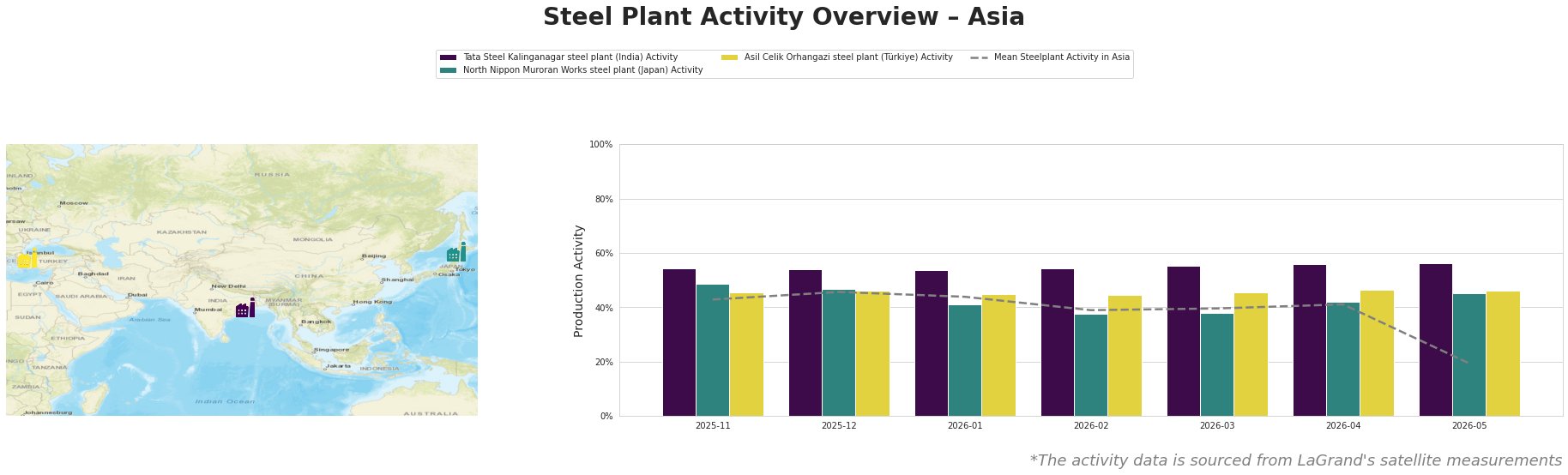
The evident drop in steel activity across the region, culminating in a mean activity level of just 19% in May 2026, marked a significant decline compared to earlier months and is symptomatic of broader economic pressures. Notably, Tata Steel Kalinganagar reached a peak activity level of 56% in April but maintained stability unlike the overall market, while the North Nippon Muroran Works demonstrated a downward shift, descending to 45% following a consistent regime. The Asil Celik Orhangazi facility, a key player in the automotive and infrastructure sectors, exhibited steadiness with an activity level of 46% in May, indicating a potential resilience amid the turmoil.
The convergence of these figures with the developments highlighted in the news articles, particularly in relation to the automotive industry’s vulnerabilities due to the tariffs, suggests that steel production might face further deterioration as the automotive sector contracts. The article “Trumps Zölle würden deutsche Hersteller laut Experten besonders treffen“ underscores the precarious position for firms reliant on exports to the EU, spotlighting how these tariffs will severely impact manufacturers lacking local production bases, with potential ripple effects on steel demand.
In light of these trends, steel buyers should consider prioritizing procurement from facilities showing stable operations like Tata Steel Kalinganagar for immediate needs, while also monitoring the North Nippon Muroran Works for strategic partnerships as activity norms adjust. Firms should prepare for potential supply disruptions especially in markets linked to automotive components, necessitating proactive stockpile strategies to mitigate risks associated with fluctuating plant activities across Asia’s steel landscape.