


From the Field to the Dashboard – Built by Experts, for Experts.
Discover What's Really Happening in the Steel Industry
Use the AI-powered search engine to analyze production activity, market trends, and news faster than ever before.
Try the Free AI Search EnginePositive Trends in Germany’s Steel Market: Government Push for Green Steel and Plant Activity Insights
Recent developments in Germany’s steel sector have sparked optimism among industry professionals, driven largely by a call from WV Stahl, as documented in the articles “WV Stahl has called on Germany to accelerate government collection of green steel” and “V. Stahl criticizes the procurement law: Transformation cannot be achieved without specific criteria”. Both articles underscore the industry’s urgent need for clearer procurement legislation to facilitate investments in sustainable steel production. While direct correlations to satellite-observed plant activity are complex, the sentiment indicates enhanced activity amid ongoing transitions toward climate-neutral technologies.
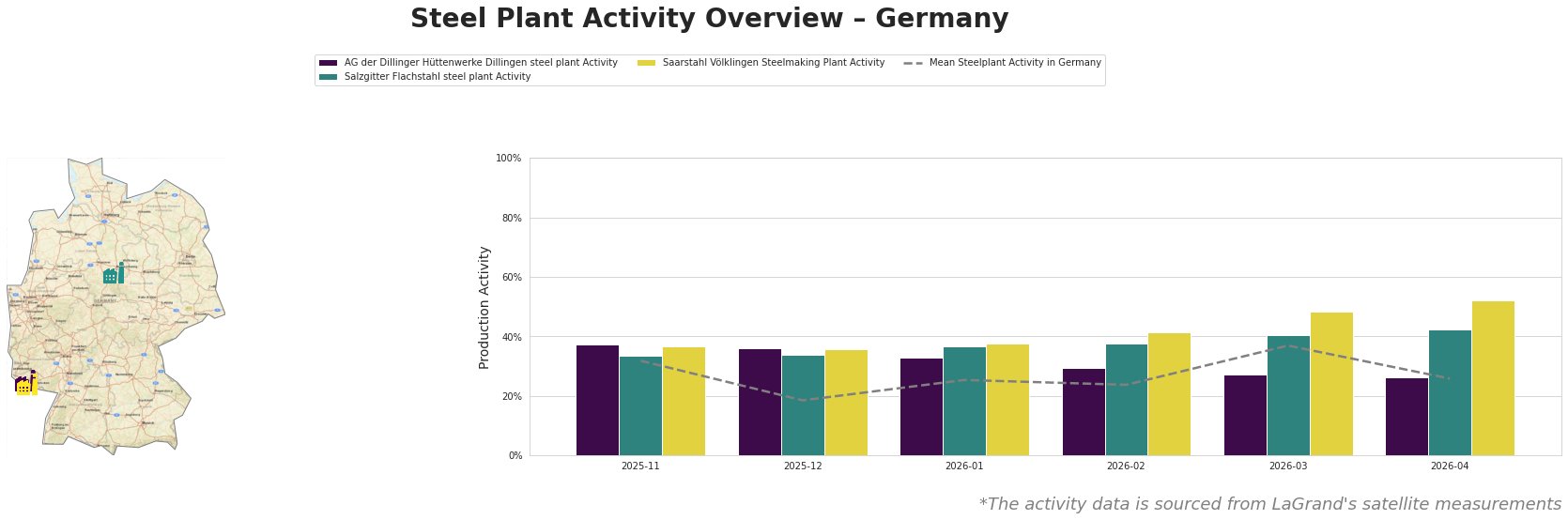
AG der Dillinger Hüttenwerke Dillingen steel plant displayed a notable drop to 26.0% activity in April 2026, sharply aligning with calls for accelerated government criteria in public procurement to ensure demand predictability highlighted in “WV Stahl has called on Germany to accelerate government collection of green steel.” Concurrently, this plant engages in producing high-strength structural steels critical for the automotive and infrastructure sectors.
Salzgitter Flachstahl showed a stable activity of 42.0% in April, benefiting from ongoing investments in green steel technologies linked to its ambitious plan to transition to hydrogen-based processes as part of its Salcos project. While it did not experience significant fluctuation, its operations are inherently linked to the demand for low CO2 steel and echo the concerns raised by WV Stahl regarding procurement standards.
Saarstahl Völklingen marked an impressive uptick to 52.0% activity, the highest among its peers, in April 2026. This increase could be attributed to the broader industry push for greener steel solutions, resonating with the critiques in articles like “V. Stahl criticizes the procurement law: Transformation cannot be achieved without specific criteria.” This plant’s use of both BOF and EAF technologies positions it favorably for adaptations in response to new government policies.
Evaluating the market climate, potential disruptions may arise if procurement laws continue to lag, especially affecting plants like AG der Dillinger Hüttenwerke. Procurement professionals should prioritize suppliers with compliant sustainability practices and stable activity levels to mitigate risks. Focus on firms like Salzgitter, which are advancing into green technologies, or Saarstahl, whose recent capacity increase aligns with the positive market sentiment. The proactive engagement with the proposed government measures is crucial for future procurement strategies, marking significant growth and readiness for sustainable transitions within the German steel landscape.