

From the Field to the Dashboard – Built by Experts, for Experts.
Discover What's Really Happening in the Steel Industry
Use the AI-powered search engine to analyze production activity, market trends, and news faster than ever before.
Try the Free AI Search EngineEurope’s Steel Market Shows Recovery and Low-Carbon Initiatives Amidst Production Challenges
In Europe, recent news highlights a nuanced steel market landscape characterized by challenges and promising developments. The article “German manufacturers report another year of recession“ discusses a decline in production over the previous four years; however, it also notes a 2.1% production increase in Q4 2025, suggesting a potential recovery despite ongoing concerns. This sentiment is echoed in satellite-observed activity data that reflects increased operational levels at certain plants, reinforcing market optimism. Additionally, “Salzgitter launches construction initiative to expand low-carbon steel solutions“ and “Salzgitter launches construction initiative to expand production of low carbon steel“ underline initiatives aimed at decarbonization, aligning with rising consumer demand for sustainable steel products.
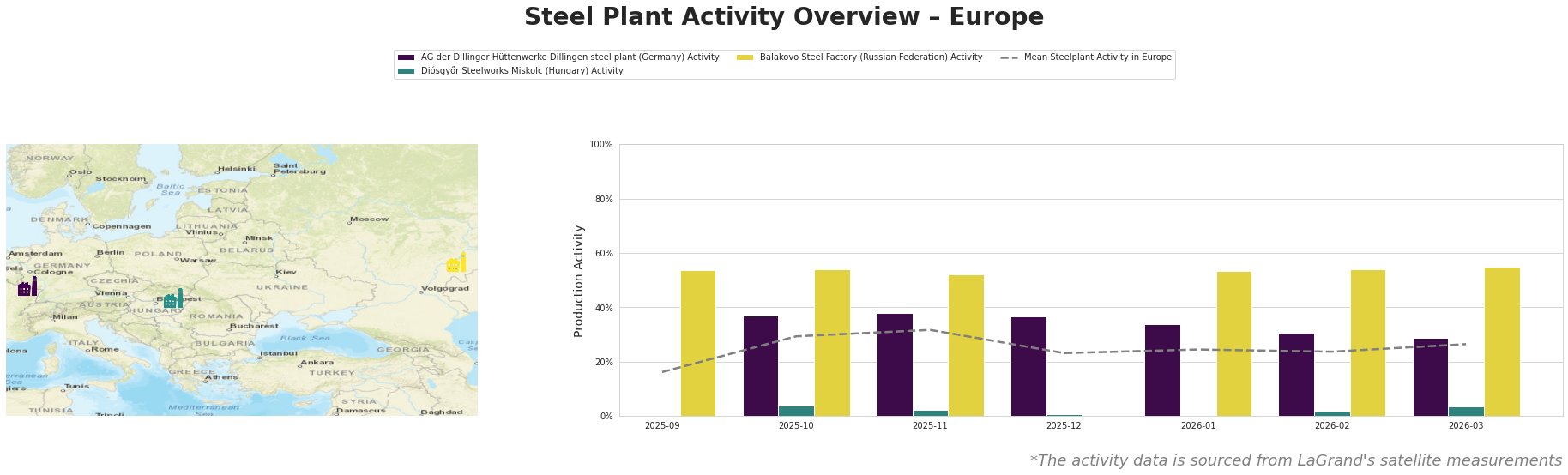
AG der Dillinger Hüttenwerke in Saarland has shown a fluctuating activity level, peaking at 38.0% in November 2025 but declining to 29.0% by March 2026. This aligns with the news of a mixed outlook, indicating resilience amid overall declines detailed in “German manufacturers report another year of recession.” However, the plant still operates below desired capacity, reflective of broader sectoral headwinds.
Diósgyőr Steelworks in Hungary experienced significant challenges, particularly a drop to 0.0% activity in January 2026. This aligns with the downbeat market sentiment from the German recession report, signaling potential supply disruptions. Notably, there are no direct correlations to initiatives or recoveries reported in the news affecting this plant.
Conversely, Balakovo Steel Factory has maintained solid operations with activity levels increasing from a baseline of 54.0% to 55.0% by March 2026. Despite political instability alluded to in the German article, the plant’s steady activity indicates limited immediate impacts.
The market is encouraged to closely monitor AG der Dillinger’s activity for signs of recovery, as positive trends in Q4 2025 suggest potential resurgence in demand largely driven by infrastructure projects highlighted by Salzgitter’s new initiatives for low-emission steel. Steel buyers should consider prioritizing procurement from Salzgitter, especially for low-carbon products aligned with decarbonization strategies. In contrast, with Diósgyőr’s unstable activity levels, stakeholders must be cautious of reliance on this facility for consistent supply, especially as it lacks recent alignment with operational advancements or market recoveries detailed in the news.