


From the Field to the Dashboard – Built by Experts, for Experts.
Discover What's Really Happening in the Steel Industry
Use the AI-powered search engine to analyze production activity, market trends, and news faster than ever before.
Try the Free AI Search EngineWeakening Steel Production in Asia: Geopolitical Tensions and Declining Demand Signal Caution for Buyers
The steel industry in Asia is currently facing significant challenges, attributed to geopolitical tensions and weakening demand, especially highlighted in the articles “Traders at IREPAS: Geopolitical tensions and higher costs disrupt steel trade flows“ and “The Middle East conflict is a stress test for steel markets.” Activity data from steel plants shows notable declines, reinforcing a negative market sentiment.
Recent satellite observations indicate a sharp decrease in overall plant activities. The mean activity level across observed plants has dropped to 19% by May 2026 from a peak of 46% in December 2025. This decline is aligned with the geopolitical disruptions mentioned in the IREPAS conference discussions, suggesting a direct link to the erosion of demand due to rising energy costs and uncertainties in trade.
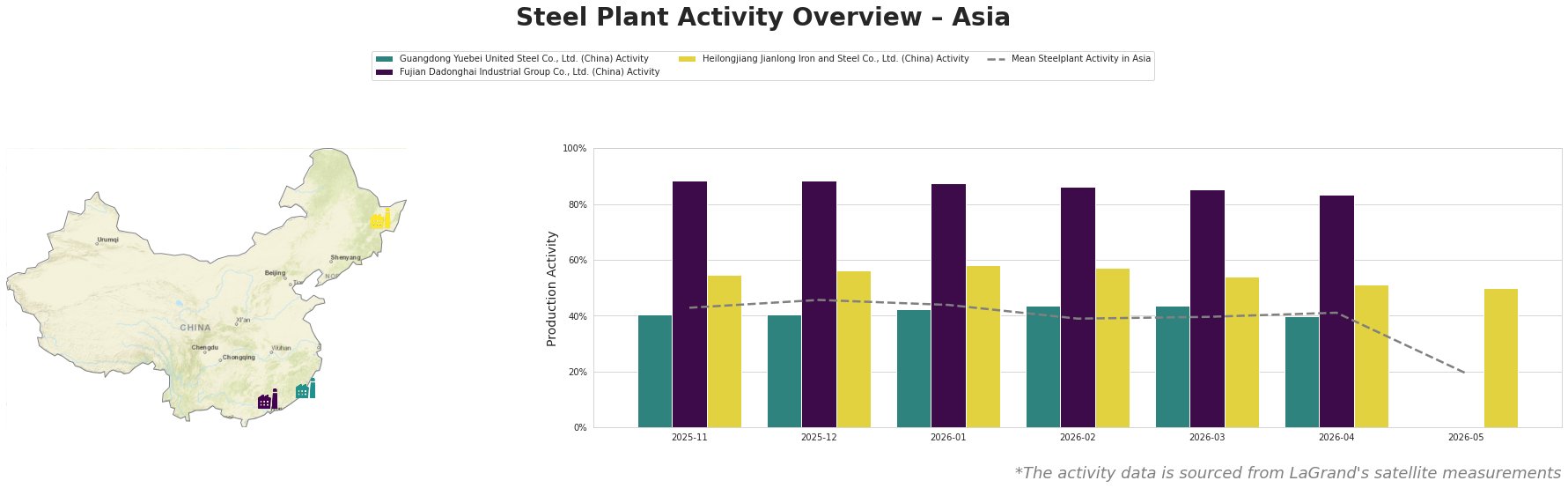
Guangdong Yuebei United Steel, exhibiting the lowest activity at 0% in May, has seen a gradual decrease from 41% in November, likely influenced by declining demand from the construction sector, as discussed in “IREPAS Traders: Geopolitical tensions and rising prices disrupt steel trade flows.” The plant primarily focuses on rebar, critical to infrastructure, and its production instability calls for immediate procurement reassessment.
Fujian Dadonghai Industrial Group maintained significant activity, reaching 89% in November but sliding to 0% in May. This drastic drop reflects the shifting market dynamics, particularly the government’s reallocation of spending away from infrastructure projects as noted in various IREPAS discussions on economic conditions.
Heilongjiang Jianlong Iron and Steel, while also declining to 50% in May, has shown more resilience, although associated uncertainties in supply chains and rising operational costs remain and correspond to the geopolitical tensions highlighted in “The Middle East conflict is a stress test for steel markets.”
Given these observations, supply disruptions seem likely, particularly from Guangdong and Fujian plants, which may struggle to meet procurement needs amidst declining production. Steel buyers should consider diversifying their sources—particularly looking into suppliers in more stable regions or exploring increased local production options to mitigate these volatility risks. Pursuing contractual agreements that prioritize supply security over cost might also be prudent during this period of uncertainty.