


From the Field to the Dashboard – Built by Experts, for Experts.
Discover What's Really Happening in the Steel Industry
Use the AI-powered search engine to analyze production activity, market trends, and news faster than ever before.
Try the Free AI Search EngineSteel Market Crisis in Asia: Dramatic Dips in Plant Activity Amid Geopolitical Strain
The steel market in Asia is facing severe downturns in activity levels due to escalating geopolitical tensions in the Middle East, significantly impacting supply chains. Recent articles, notably “Kuwait cuts crude output after Hormuz disruption“ and “Kuwait cuts crude output on Hormuz disruption: Update,” underscore how disruptions to regional oil exports are influencing broader industrial production, including steel manufacturing.
Recent Activity Trends
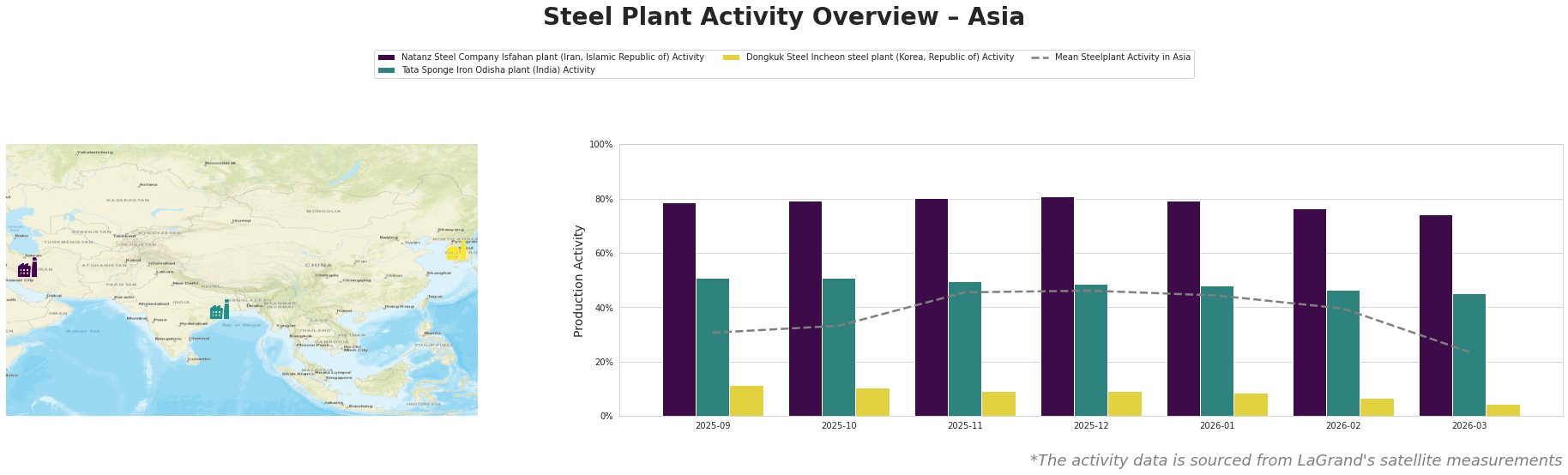
Steelplant activity has plunged significantly since the onset of heightened geopolitical tensions, with the mean activity dropping sharply to 24.0% by the end of March 2026. Notably, Dongkuk Steel’s activity fell from 11.0% to just 4.0%, while Tata Sponge Iron experienced a decline from 51.0% to 45.0%, reflecting deeper market vulnerabilities. Conversely, Natanz Steel’s activity saw a more modest drop from 79.0% to 74.0%, suggesting it may be comparatively insulated from the immediate impacts of the Middle East conflict.
Evaluated Market Implications
The observed reductions in plant activity, particularly at Dongkuk Steel Incheon and Tata Sponge Iron, directly correlate with the disruptions highlighted in “Kuwait cuts crude output after Hormuz disruption” and “Kuwait cuts crude output on Hormuz disruption: Update.” The ongoing conflict in the Middle East has not only curtailed oil exports but is also threatening supply continuity for steel production reliant on stable energy inputs.
Given that Kuwait and other Gulf nations are signaling potential production cuts and supply chain disruptions, steel buyers should prepare for possible shortages, particularly in finished steel products from regions sensitive to these developments. Buyers are advised to:
- Increase inventory levels now to buffer against imminent supply shortages, particularly focusing on low-activity plants with long lead times.
- Explore alternative suppliers within less affected regions or diversify procurement strategies to mitigate risks stemming from instability in the Middle East.
- Stay abreast of geopolitical developments that could further impact energy and raw material supplies, influencing pricing structures in the regional market.
By closely monitoring both satellite-observed plant activities and geopolitical developments, market analysts can better anticipate trends and adjustments necessary in procurement strategies for the foreseeable future.