


From the Field to the Dashboard – Built by Experts, for Experts.
Discover What's Really Happening in the Steel Industry
Use the AI-powered search engine to analyze production activity, market trends, and news faster than ever before.
Try the Free AI Search EnginePositive Steel Market Momentum in North America Driven by Trade Developments
Recent trends in North America’s steel market reflect a positive sentiment largely influenced by rising plant activity levels amidst recent trade dynamics. The articles US-Handelspolitik: Trump kündigt Zölle von 25 Prozent auf Pkw und Lkw an – EU droht mit Gegenmaßnahmen and Trump threatens to raise tariffs on European cars and trucks highlight escalating tariff tensions that could impact domestic production. Notably, these developments coincide with satellite-observed increases in operational activity at select steel plants, indicating a responsive adjustment to shifting market conditions.
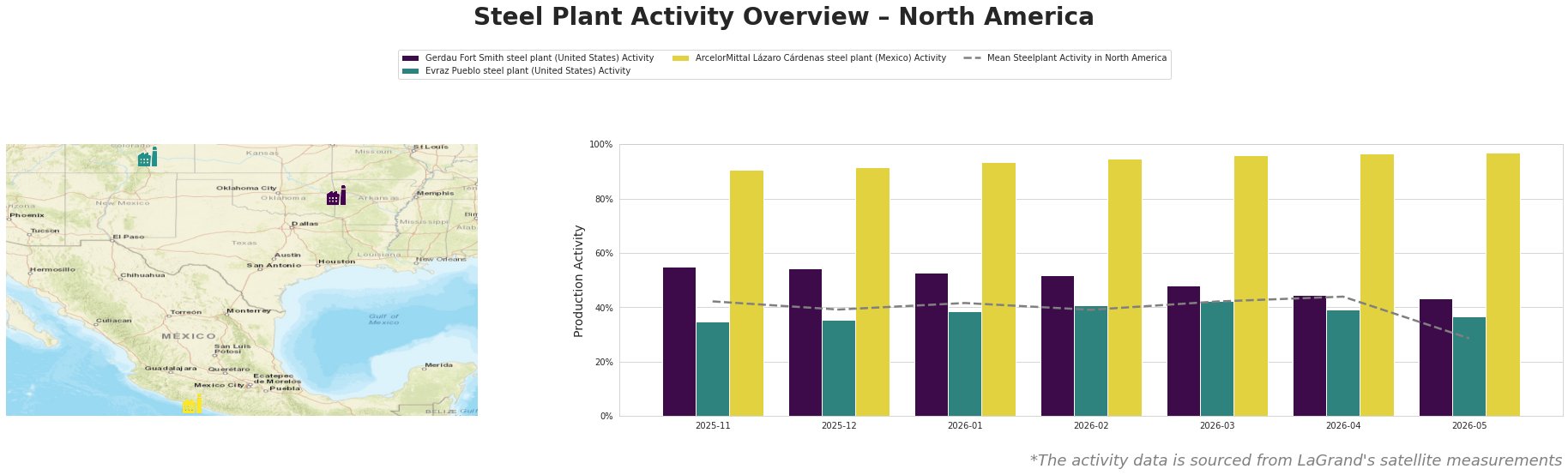
The Gerdau Fort Smith steel plant in Arkansas, which operates an electric arc furnace, saw a modest decrease in activity from 55% to 43% over May, despite being above the mean. This decline aligns with increasing trade tensions but was countered by strong demand domestically, as indicated by Trump threatens to raise tariffs on European cars and trucks, signaling potential import limitations.
The Evraz Pueblo steel plant shows a decline from 35% to 37% in activity, reflective of fluctuations but remains closer to historical averages, linked indirectly to tariffs affecting the transport sector, where Evraz plays a pivotal role with its finished rolled products, including rail and wire rod.
Significantly, the ArcelorMittal Lázaro Cárdenas plant in Mexico displays strong resilience, maintaining a peak activity of 97%. The robust performance here may indicate a strategic adjustment in response to U.S. policy shifts, particularly as tensions rise, suggesting an opportunity for U.S. buyers to source from secure and high-activity locations.
Potential supply disruptions could arise in the Gerdau Fort Smith and Evraz Pueblo facilities if tariff escalations affect demand directly; thus, steel buyers should consider securing additional short-term contracts with these producers. Additionally, increased reliance on the Lázaro Cárdenas plant might prove to be beneficial for procurement strategies, based on its stable performance and capacity to meet rising demand amidst changing market dynamics.
Actionable steps for steel buyers include actively monitoring the impact of tariffs and considering alternative sourcing strategies from Mexican operations to mitigate risks stemming from U.S. domestic fluctuations.