


From the Field to the Dashboard – Built by Experts, for Experts.
Discover What's Really Happening in the Steel Industry
Use the AI-powered search engine to analyze production activity, market trends, and news faster than ever before.
Try the Free AI Search EnginePositive Outlook for the European Steel Market: Plant Activity Gains and Support for Climate Initiatives
Germany’s steel market is experiencing a positive shift driven by recent policy initiatives and increasing activity at key steel plants. Notable articles such as “Wirtschaftsministerin Reiche will Ökostrom-Förderung erheblich verringern“ and “German steelmakers supported the government’s new climate protection program“ reveal significant changes in energy procurement strategies, directly impacting production costs and market demand. Additionally, satellite data indicates increasing activity levels at several European steel plants, suggesting a responsive and dynamic market environment.
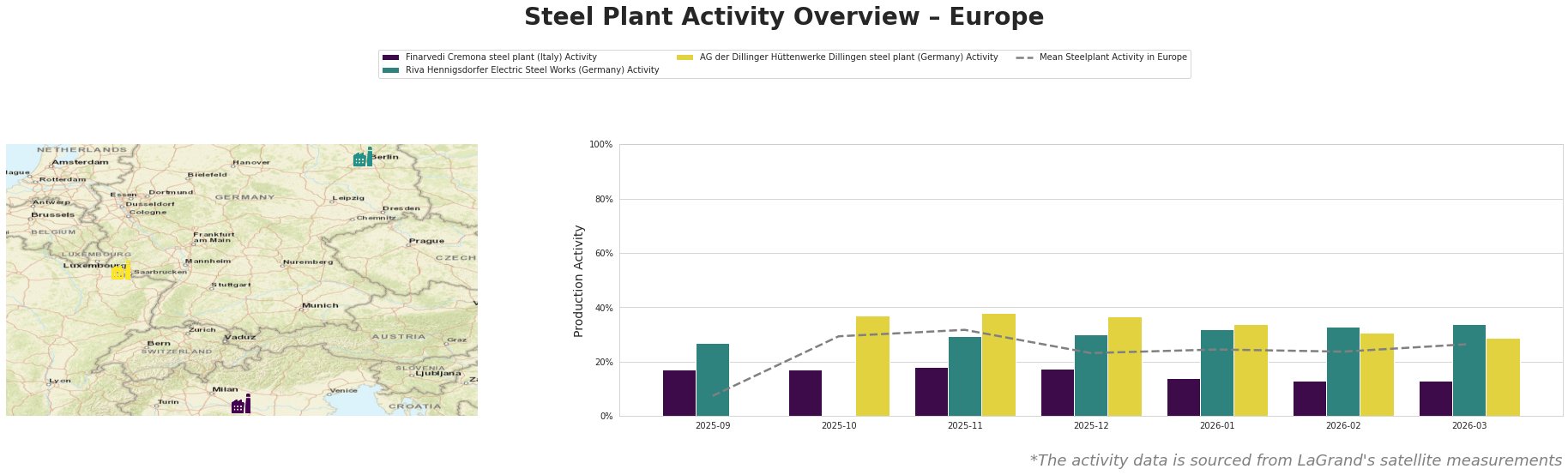
The Finarvedi Cremona steel plant showed consistent activity around 17% until a slight increase to 18% in November. However, it declined to 13% by March 2026, with no direct connection to the articles discussed, suggesting potential operational challenges amidst the broader market positivity. In contrast, the Riva Hennigsdorfer Electric Steel Works continued to show stable performance with 34% activity in March 2026, although activity dropped from a peak of 34%, which aligns with the positive market sentiment following government incentives regarding green steel production. Finally, AG der Dillinger Hüttenwerke Dillingen experienced a strong showing at 38% in November, indicative of increasing demand supported by a robust climate action framework, as stated in “German steelmakers supported the government’s new climate protection program.”
With the new climate program, Germany plans to reduce emissions substantially and enhance green steel procurement through government support. The inability of Deutsche Bahn to secure substantial contracts for green steel (“German railways slowest in adopting green steel: conference“) emphasizes a lag in the market that may present future procurement opportunities for proactive steel buyers aiming to engage with more effective suppliers.
In light of these developments, steel buyers should focus on:
- Engaging with AG der Dillinger Hüttenwerke Dillingen for steady supplies of high-performance steel products, capitalizing on its robust output amid increasing climate initiatives.
- Exploring procurement options with Riva Hennigsdorfer Electric Steel Works, particularly for automotive applications, given its appealing activity levels despite slight fluctuations.
- Monitoring the Finarvedi Cremona plant’s operational adjustments as it aligns resources to adapt to policy changes, presenting potential cost-effective procurement pathways.
Adapting procurement strategies to these dynamic activity levels and recent policy changes will provide steel buyers with a competitive edge in the thriving European steel market.