


From the Field to the Dashboard – Built by Experts, for Experts.
Discover What's Really Happening in the Steel Industry
Use the AI-powered search engine to analyze production activity, market trends, and news faster than ever before.
Try the Free AI Search EnginePositive Outlook for South America’s Steel Market: Brazil’s Export Surge and Import Declines
Brazilian steel market activity shows promising trends amid rising exports and declining imports, reinforcing a robust sentiment for the region. Recent reports indicate that “Brazilian HDG exports surge 330 percent in April as imports fall 71 percent” and “In April Brazil rebar exports rise on stronger shipments to South America, while imports fell on no Egyptian supply.” These developments are reflected in satellite observations of key steel plants, showing variances in production activity that align with the export growth narrative.
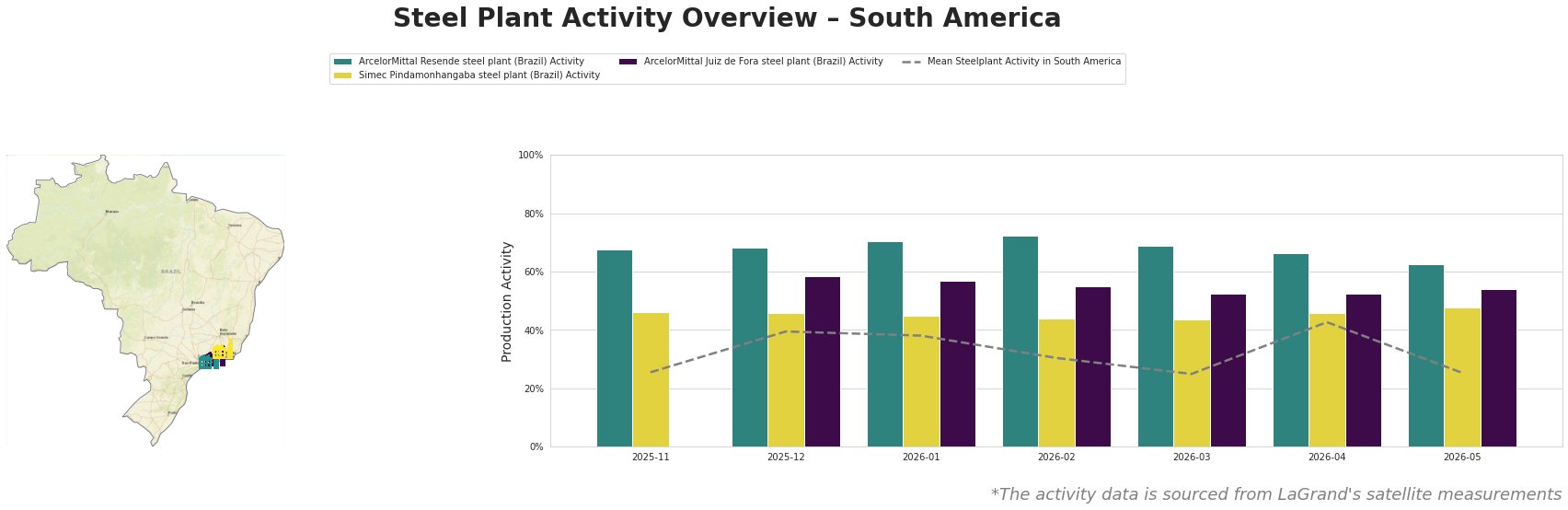
Recent activity indicates a fluctuating but recovering trend in steel plant operations. The Simec Pindamonhangaba plant showcases relative stability, maintaining activity levels between 44% and 48%, while aligning with rising domestic rebar exports documented in “In April Brazil rebar exports rise on stronger shipments to South America.” The ArcelorMittal Juiz de Fora plant experienced a peak in activity of 58% in December 2025 but has since stabilized. However, the ArcelorMittal Resende plant declined from 72% in February to 63% in May without a direct corresponding news event, indicating potential internal operational factors.
As revealed in “Brazil’s finished steel trade deficit narrows on antidumping measures“, the narrowing deficit highlights reduced import reliance, translating into more favorable domestic pricing conditions. This is confirmed as “Brazil’s steel imports begin to decline amid antidumping measures,” which will likely benefit local steel buyers through short-term pricing stability.
Steel buyers should consider ramping up procurement from Brazilian suppliers, particularly Usiminas and Gerdau, which are positioned favorably to meet increasing demand, as indicated by heightened export activities in the HDG and rebar segments. With Gerdau leading recent rebar exports, this presents a critical opportunity for buyers to secure imports before anticipated price fluctuations might arise due to stabilizing inventories and increasing domestic consumption. Avoiding reliance on imports that have significantly dropped due to antidumping measures, alongside monitoring activity at key plants, will be crucial for maintaining supply chain resilience in South America’s evolving steel market.