


From the Field to the Dashboard – Built by Experts, for Experts.
Discover What's Really Happening in the Steel Industry
Use the AI-powered search engine to analyze production activity, market trends, and news faster than ever before.
Try the Free AI Search EnginePositive Growth in Asian Steel Market: India Poised for 8% Production Increase by FY2027
Indian steel production is set to rise significantly, with forecasts predicting an 8% year-on-year increase in total output for the FY2026/2027 period. Major developments, including potential disruptions and procurement recommendations, stem from recent articles titled “Steel production in India could rise by 8% y/y in the FY2026/2027 – forecast“ and “India’s crude steel production growth expected to slow in FY’27 but consumption may recover faster year on year,” which highlight consistent growth in demand and production nuances in the Indian steel market. Enhanced activity levels in key plants confirm these predictions, specifically in line with rising domestic consumption driven by the construction sector.
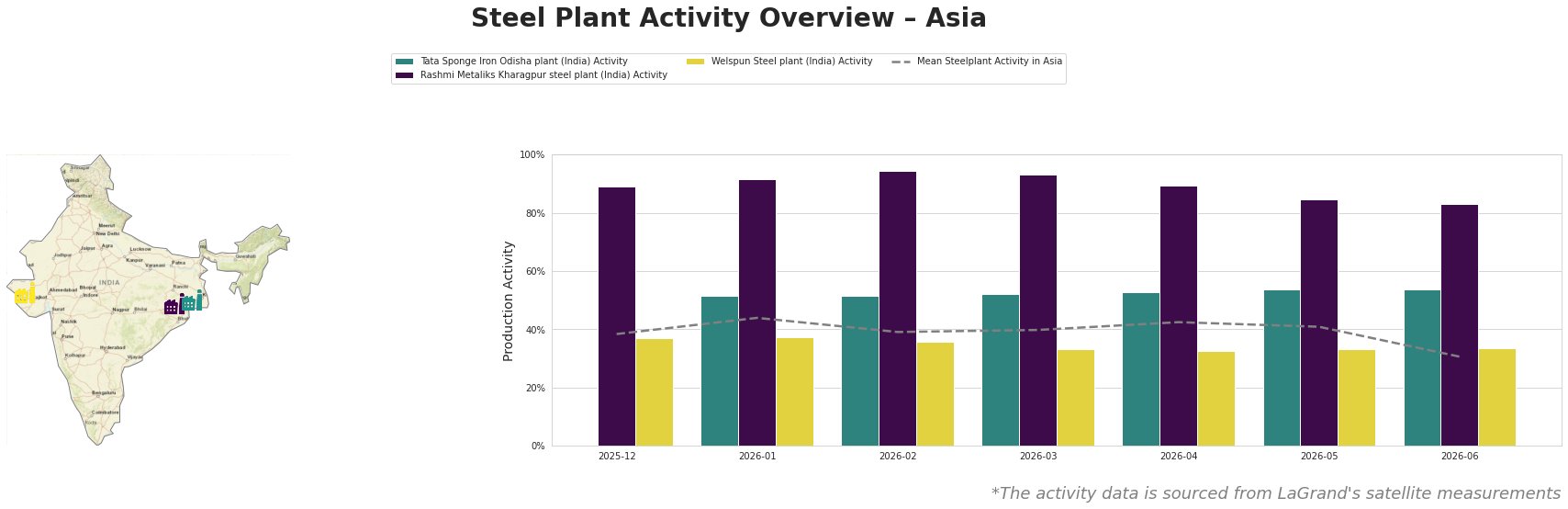
Activity levels across selected plants showed significant fluctuation. The Rashmi Metaliks Kharagpur steel plant peaked in January 2026 with a notable activity level of 92% before experiencing a decline. In contrast, Tata Sponge Iron Odisha maintained steady activity, indicating resilience in operations despite market fluctuations. The Welspun Steel plant showed lower activity overall, averaging around 34% in mid-2026, which aligns with slower growth projected in its operational capacity.
The improvements in the Tata Sponge Iron plant can be loosely associated with the optimistic consumption forecast outlined in “Steel production in India could rise by 8% y/y in the FY2026/2027 – forecast.” However, Rashmi’s drop, despite high production capacity, may not directly correlate with recent demand increases, indicating potential internal operational challenges. The steady rise in iron ore imports—highlighted in “India’s iron ore imports rose by 50 per cent y/y in the first five months“—further supports rising operating activity in domestic steel plants.
As procurement strategies are formulated, the strong indications of an upcoming production increase suggest actionable steps for buyers. Steel professionals should consider securing contracts proactively before anticipated increases in steel prices due to heightened consumption. Considering imports, the emphasis on sourcing from reliable iron ore suppliers highlighted in “BHP and Rio Tinto see growth potential in India and ASEAN“ becomes crucial to maintaining a stable raw material flow. Adapting procurement strategies to align with domestic capacity increases and consumption growth in construction could mitigate any risks of supply disruption in the evolving Asian steel market.