


From the Field to the Dashboard – Built by Experts, for Experts.
Discover What's Really Happening in the Steel Industry
Use the AI-powered search engine to analyze production activity, market trends, and news faster than ever before.
Try the Free AI Search EngineNorth America Steel Market Update: Neutral Sentiment Amid Trade Policy Impacts and Plant Activity Fluctuations
Recent observations in North America’s steel industry indicate a neutral market sentiment, primarily influenced by shifting trade dynamics. The articles titled Cell phone data shows Trump’s trade policies are hurting more than just Canadian tourism and Behind summit smiles, Xi gives blunt warning to Trump of ‘clashes’ and ‘conflicts’ emphasize the economic ripple effects stemming from U.S.-China trade relations, which have led to reduced activity levels in key steel facilities. However, a direct linkage between these news items and recent satellite data from steel plants wasn’t established.
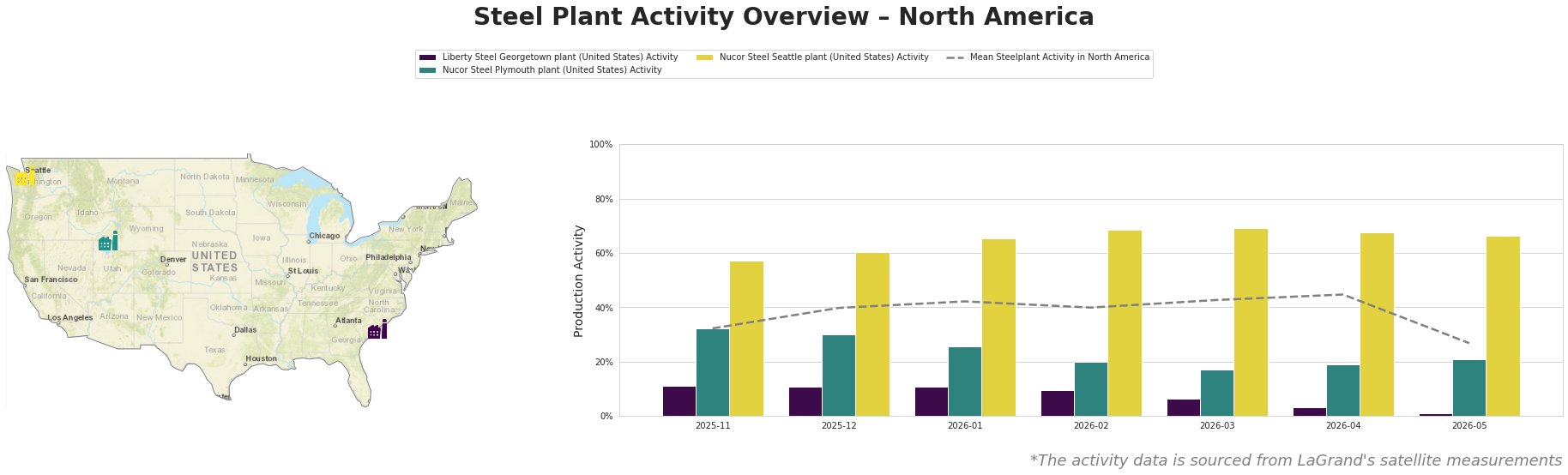
Activity levels across the monitored plants show a downward trend, particularly evident at the Liberty Steel Georgetown plant, which plummeted from 11% to 1% from December 2025 to May 2026. This notable reduction in activity may reflect the wider implications of U.S. trade policies, although no direct correlation to the cited articles was established. Conversely, the Nucor Steel Seattle plant has maintained relatively higher activity levels, while the Plymouth facility exhibited sporadic activity drops, aligning with potential market uncertainties defined in the aforementioned reports.
The Liberty Steel Georgetown plant, located in South Carolina, operates mainly through electric arc furnace (EAF) technology, focusing on semi-finished and finished rolled products. The observed decline to 1% in May may indicate destabilization from trade policies impacting consumer demand, as stated in the article on tourism’s economic consequences.
From Utah, Nucor Steel Plymouth has shown fluctuating activity, dropping to 21% in May 2026. The correlation with ongoing trade tensions, particularly highlighted in the summit discussions, is tenuous but underscores the sector’s vulnerabilities.
The Nucor Steel Seattle plant remained more stable, recorded at 66% in May 2026, which could reflect regional demand resilience or varying operational factors distinct from those affecting its counterparts.
Given the current dynamics, steel buyers should prepare for potential supply disruptions, particularly from the Liberty Steel Georgetown plant, and consider strategically diversifying procurement sources. Regular monitoring and direct communication with suppliers could mitigate risks associated with changing tariffs and trade policies that affect material availability.