


From the Field to the Dashboard – Built by Experts, for Experts.
Discover What's Really Happening in the Steel Industry
Use the AI-powered search engine to analyze production activity, market trends, and news faster than ever before.
Try the Free AI Search EngineNegative Sentiment in the European Steel Market: Impacts of Germany’s Heating Law
Recent developments in Europe highlight a concerning shift in the steel market, particularly linked to Germany’s proposed heating legislation. Articles titled “German heating proposals ‘jeopardise climate targets’“ and “Deutschland-Blog: Grüne warnen vor ‘neuer Heizkostenfalle’” illustrate that reforms aimed at regulating gas and oil heating may compromise climate objectives and increase operational costs. These legislative changes coincide with notable activity declines observed in steel plants, particularly in Poland and Switzerland, although a direct correlation between the two remains challenging to establish.
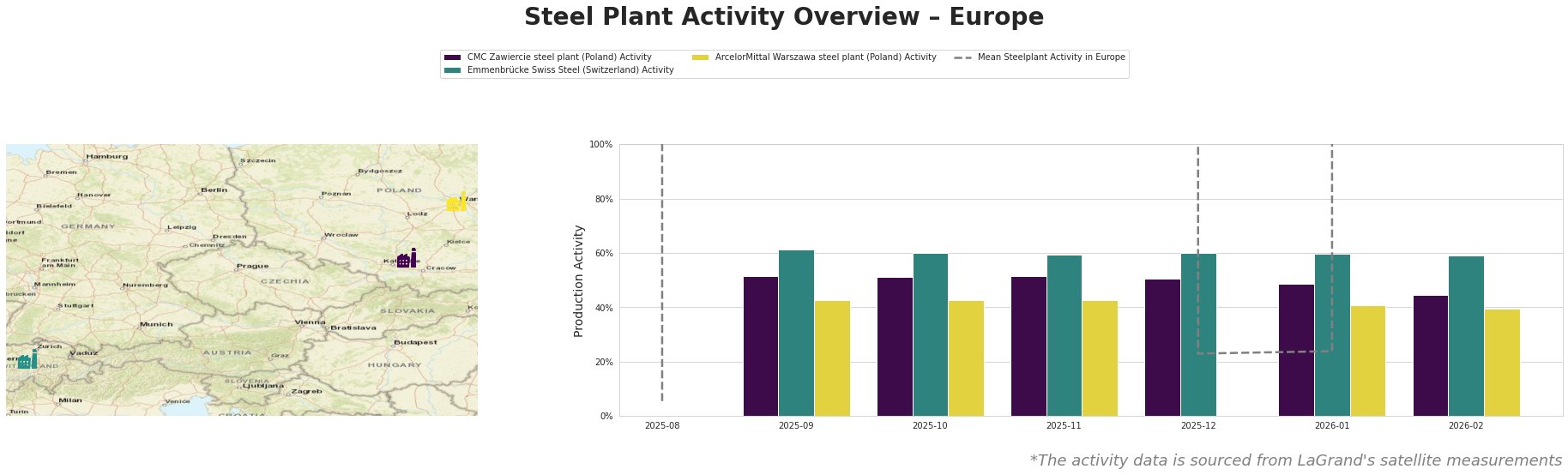
The CMC Zawiercie steel plant in Poland has shown a steady decline from an activity level of 51% in November to 45% by the end of February, suggesting potential operational challenges, possibly related to fluctuating demand landscapes exacerbated by regulatory uncertainty. This connects indirectly to the discussions surrounding heating law reforms and the implications for energy consumption in related sectors. However, no direct evidence ties this decline to the articles cited.
The Emmenbrücke Swiss Steel plant has maintained relatively high activity levels, reducing slightly from 61% to 59%, indicating stable operations amidst market turbulence. Here too, while local factors may contribute to performance, the legislative shift surrounding heating does not establish a clear causal link.
In contrast, the ArcelorMittal Warszawa plant’s activity fell from 43% in September to 40% by February, indicative of dwindling efficiency and possibly hinting at tightening supply chains or market pullbacks.
The overall negative sentiment in the steel market signals potential supply disruptions, particularly in Poland, necessitating proactive procurement strategies. Steel buyers should closely monitor these legislative developments, adjusting procurement commitments in anticipation of escalating costs linked to heating reform implementations. Recommendation includes securing short-term contracts and maintaining flexible positioning in steel inventories to mitigate risk linked to fluctuating plant outputs, especially from impacted regions.