


From the Field to the Dashboard – Built by Experts, for Experts.
Discover What's Really Happening in the Steel Industry
Use the AI-powered search engine to analyze production activity, market trends, and news faster than ever before.
Try the Free AI Search EngineNegative Sentiment in Iran’s Steel Market: Declining Activity Amid Political Tensions
Recent developments in the Iranian steel industry reveal a disturbing trend marked by declining plant activity levels. Notably, the articles “Trump: Ohne Deal wird es ‘sehr traumatisch’ für Iran | FAZ” and “Sicherheitskonferenz: ++ 200.000 Menschen demonstrieren gegen Mullah-Herrschaft – Schah-Sohn fleht Trump um Hilfe an ++ Liveticker“ illustrate the escalating political tensions and the potential for further instability, directly correlating with the drop in operational activity in various steel plants.
Measured Activity Overview
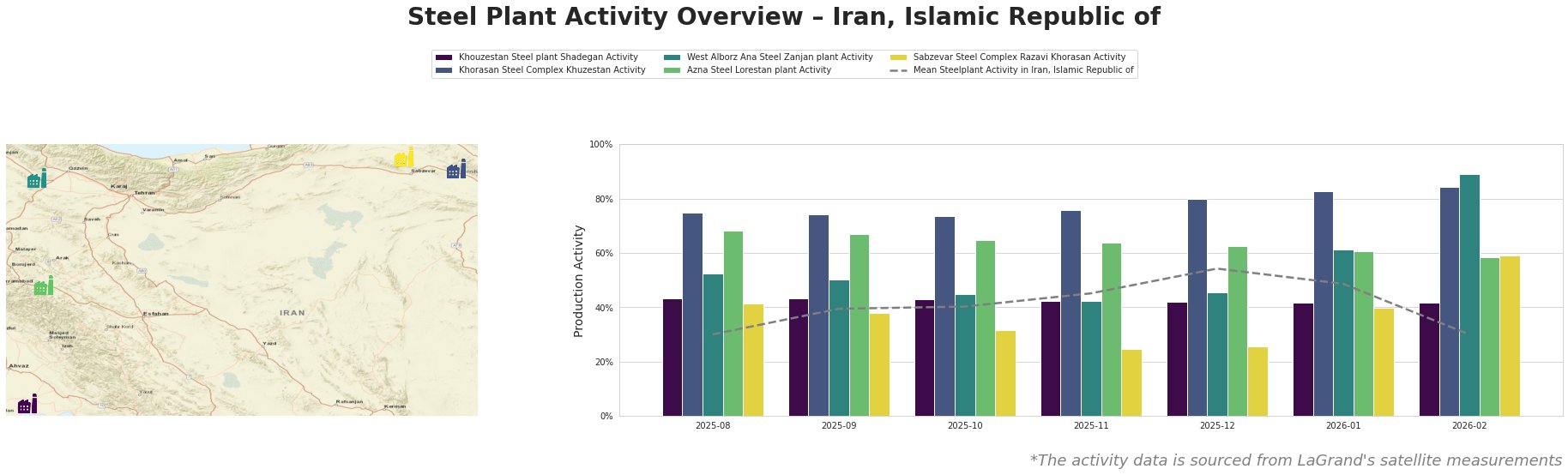
Activity levels in Iran’s steel plants have seen a marked decline, particularly in February 2026, where the overall mean activity plummeted to 30.0%, reflecting significant operational challenges. A notable fall is observed in Azna Steel Lorestan, decreasing from 68.0% in August to just 59.0%. This downturn aligns with the heightened tensions surrounding diplomatic discourse and military posturing referenced in the aforementioned news articles, indicating a potential direct relationship between declining operational capacity and prevailing political instability.
Khouzestan Steel plant Shadegan’s activity has remained relatively stable, yet at a lower threshold (42.0% in recent months), which shows minimal resilience in the face of adverse market conditions. Other plants, such as West Alborz Ana Steel and Khorasan Steel Complex, exhibit more volatile behavior with recent operational peaks but still fall below their historical averages, further indicating an unstable market sentiment and operational environment.
Evaluated Market Implications
The persistent operational declines coupled with the geopolitical landscape posited by articles regarding U.S. military concerns and public dissent against the Iranian regime suggest potential supply disruptions within the market. The “Liveblog USA unter Trump: Trump – Machtwechsel im Iran wäre „das Beste” | FAZ” underscores the fragility of Iran’s steel supply chain as internal political strife may further exacerbate production inconsistencies.
Steel buyers are advised to consider the following actions:
– Diversify Procurement Sources: Given the volatility in plant performance and potential supply chains, explore alternative sources outside of Iran to mitigate risks associated with production halts.
– Monitor Political Developments Closely: Stay updated on political news that may influence the steel market directly, especially related to U.S.-Iran relations, and adjust procurement strategies accordingly.
– Engage with Distribution Networks: Strengthen relationships with local and regional distributors who may have better insights into the ongoing market situation and can provide contingencies against supply disruptions.
Overall, the current landscape requires acute awareness and proactive management of procurement strategies to navigate the turbulent environment impacting Iran’s steel industry.