


From the Field to the Dashboard – Built by Experts, for Experts.
Discover What's Really Happening in the Steel Industry
Use the AI-powered search engine to analyze production activity, market trends, and news faster than ever before.
Try the Free AI Search EngineEuropean Steel Market Insights: Strong Recovery Signals Amidst Mixed Activity Trends
European steel markets are currently witnessing a very positive sentiment driven by significant fluctuations in plant activities, particularly in Ukraine, amidst broader regional developments. Recent activity data aligns with news reports such as “Rail shipments of iron and steel products fell by 14.7% y/y in Q1“ and “Ukraine saw a 60.5% y/y decline in long steel exports in Q1“, affirming a complex but encouraging landscape for steel procurement.
In the first quarter of 2026, plant activity dynamics in Europe reveal fluctuating levels across key facilities:
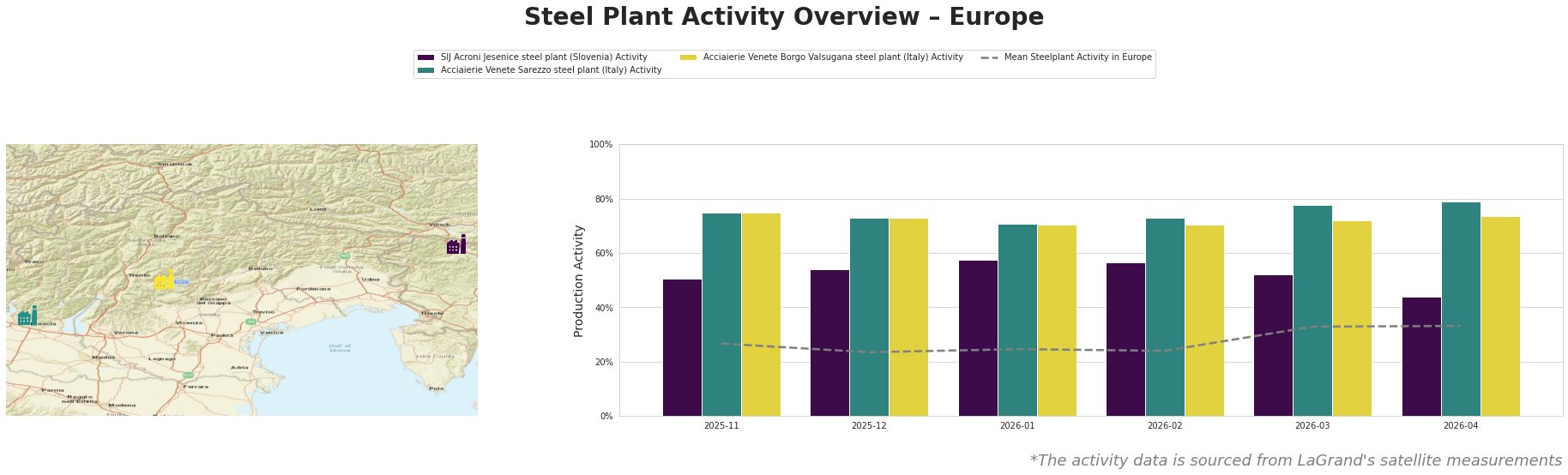
The SIJ Acroni Jesenice steel plant in Slovenia maintained considerable activity levels around 51.0% to 58.0% throughout late 2025 and early 2026, despite a notable dip to 44.0% in April. This decline could be indirectly associated with the reduced import levels reported in “Ukraine reduced imports of flat steel by 12.8% y/y in January–March,” reflecting potential supply chain constraints.
Conversely, the Acciaierie Venete Sarezzo and Borgo Valsugana plants showed strong resilience, with activity peaking at 79.0% and 74.0% respectively, in April 2026, positioning them favorably to capitalize on demand within the automotive and infrastructure sectors. This surge coincides with the 63.9% increase in long steel imports reported by Ukraine in “Ukraine increased imports of long steel products by 63.9% y/y in Q1,” suggesting an interlinked reaction to both declining exports and rising import needs.
Evaluated market implications reveal a potential supply disruption, particularly in long steel products, due to significant declines in export volumes from Ukraine. Steel buyers are recommended to prioritize procurement from European suppliers like Acciaierie Venete, given their robust production capacity and recent activity spikes, ensuring a more stable supply chain. Additionally, they should closely monitor market responses to the ongoing volatility in rail shipments highlighted in “Rail shipments of iron and steel products fell by 14.7% y/y in Q1,” forecasting further shifts in pricing and availability.