


From the Field to the Dashboard – Built by Experts, for Experts.
Discover What's Really Happening in the Steel Industry
Use the AI-powered search engine to analyze production activity, market trends, and news faster than ever before.
Try the Free AI Search EngineChina’s Steel Market Dynamics: Production Decline and Activity Insights through April 2026
China’s steel industry has faced a challenging environment with a reported decline in production. Specifically, China’s steel output fell by 4% y/y in January–April as stated by the National Bureau of Statistics. This decrease aligns with satellite-observed data showing fluctuating activity levels across key steel plants, reflecting wider constraints in the industry.
Measured Activity Overview
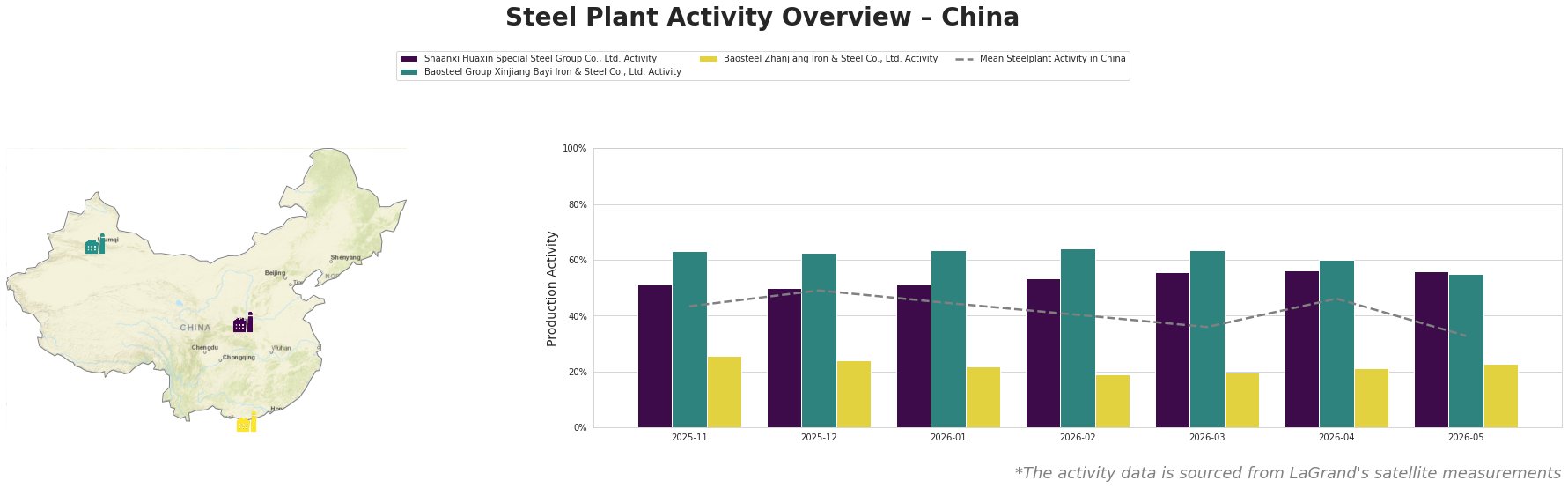
Activity levels for the Shaanxi Huaxin Special Steel Group exhibited stability but slightly decreased to 56% by April 2026, reflecting a drop that mirrors industry-wide challenges. This reduction can be indirectly connected to the overall production decrease noted in China’s crude steel output down 3.5 percent in April 2026, maintaining downtrend in Jan-Apr.
Baosteel Group Xinjiang has also seen slight fluctuations but maintained higher activity (peaking at 64% in January 2026), suggesting a relatively stable operational consistency. Baosteel Zhanjiang, however, displayed more volatility, declining to 19% in February, before recovering partially to 23% by the end of May. The downward trajectory aligns with the drop in production noted in Global steel production falls by 4.1% m/m in April.
Evaluated Market Implications
There are potential supply disruptions identified, particularly for Baosteel Zhanjiang, where significant activity declines may impact availability in the finished rolled products segment. Steel buyers should monitor this plant closely due to its pronounced operational variability and its contribution to overall supply levels.
In light of the decline in production and the reported 9.7% decline in rolled steel exports, analysts should consider a strategic approach to procurement, emphasizing engagement with suppliers that are maintaining stable production levels, such as Baosteel Group Xinjiang. Securing contracts or increasing orders with this entity may buffer purchasers against potential shortfalls from less consistent suppliers.
Overall, while the overall sentiment remains neutral, the produced data indicates a shift toward a cautious procurement strategy, particularly focusing on established relationships with steel producers who demonstrate resilience amid the surrounding downturn.