


From the Field to the Dashboard – Built by Experts, for Experts.
Discover What's Really Happening in the Steel Industry
Use the AI-powered search engine to analyze production activity, market trends, and news faster than ever before.
Try the Free AI Search EngineAsian Steel Market Insights: Coking Coal Demand and Activity Trends Amid Neutral Sentiment
Recent developments in the Asian steel market are marked by China’s coking coal imports increasing by 25% y/y over the past five months, which correlates with notable fluctuations in plant activity levels. This increase in coking coal imports is driven by constraints in domestic supply due to mining accidents, as indicated in the article “China has increased coking coal imports by 25% y/y over the past five months“.
Measured Activity Overview
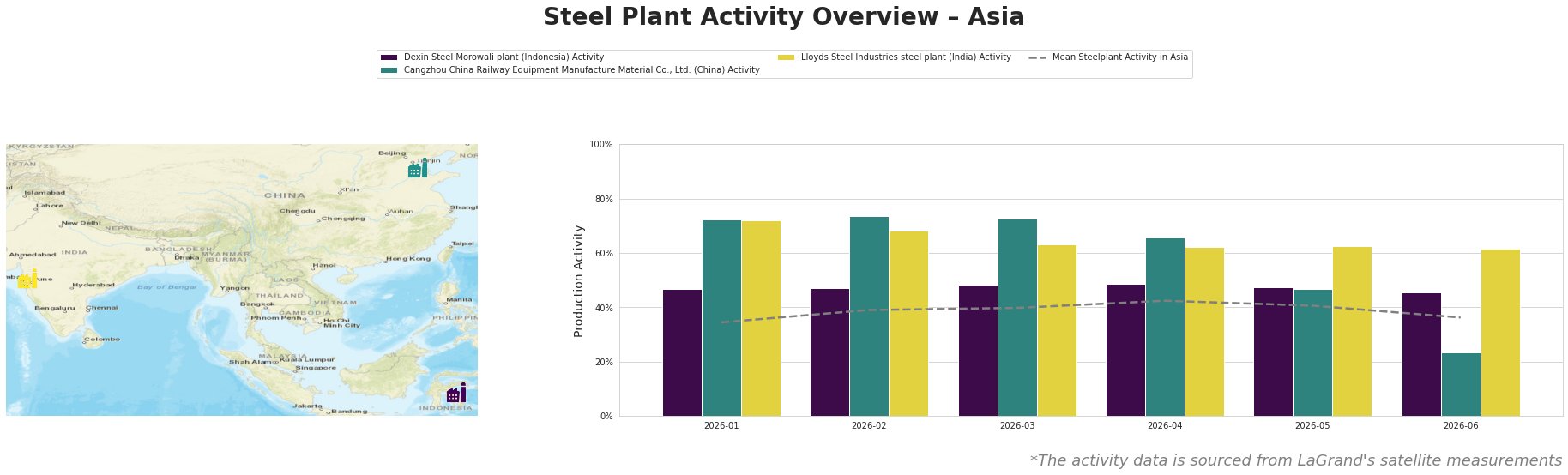
The activity levels of major steel plants suggest a varied operational landscape. Notably, Cangzhou China Railway Equipment Manufacture Material Co., Ltd. experienced a sharp decline to 23% activity in June, contrasting sharply with a historical activity mean of 36% for the region. This decline could relate to weak demand reflected in the article “CISA mills’ daily crude steel output up 0.8% in mid-June 2026, stocks also up.” Conversely, the Dexin Steel Morowali plant has shown stable operations, averaging between 45% to 49% activity, signifying resilience amid fluctuating market demands.
Dexin Steel Morowali Plant
With a crude steel capacity of 3,500 kt, utilizing a blast furnace (BF) and basic oxygen furnace (BOF) for integrated steel production, the Dexin Steel Morowali plant has maintained a steady output. Its activity dipped slightly to 45% in June but generally remained stable. This stability is notable given the increases in coking coal imports tied to domestic supply challenges, though no direct connection to the plant’s operational changes has been established.
Cangzhou China Railway Equipment Manufacture Material Co., Ltd.
This plant, with a capacity of 7,500 kt, saw its activity plummet to 23% in June, down from an average of 73% earlier in the year. This decline aligns with broader market trends of increasing steel inventories, as stated in “CISA mills’ daily crude steel output up 0.8% in mid-June 2026, stocks also up.” The reduced production aligns with weak demand, suggesting a potential overcapacity risk in the market.
Lloyds Steel Industries Plant
The Lloyds Steel Industries plant in India has retained a consistent activity level at 62% in June. Despite the overall neutral market sentiment, this plant’s operations remain stable, indicating robust demand in the energy and tools sector, which can provide a buffer against supply dynamics sometimes influenced by geopolitical tensions reported in “CSC: China production cuts and geopolitical tensions tighten global steel supply.”
Evaluated Market Implications
The current neutral sentiment points to potential supply disruptions primarily influenced by geopolitical factors and domestic supply shortages, particularly in China. Cangzhou’s significant drop in activity signals a need for careful procurement strategies from buyers focused on maintaining inventory levels aligned with fluctuating demand.
Steel buyers should consider:
– Increasing procurement of high-quality coking coal to mitigate risks associated with potential supply constrictions as highlighted by “Prices for coking coal rose in June.”
– Monitoring inventory levels, especially for finished products, at Cangzhou, given the 6.1% rise in stocks, which could pressure pricing and availability in the market.
These insights underscore the importance of strategic purchasing and inventory management in the current Asian steel market, with a close watch on coking coal price dynamics and local production capacities essential for informed decision-making.