


From the Field to the Dashboard – Built by Experts, for Experts.
Discover What's Really Happening in the Steel Industry
Use the AI-powered search engine to analyze production activity, market trends, and news faster than ever before.
Try the Free AI Search EngineAsia Steel Market Report: Alarming Activity Decline Amidst Heightening Global Competition
Asia’s steel market is facing severe headwinds, marked by declining activity across key producers as highlighted in China: Zölle retten Europas Industrie nicht and Wettbewerb mit USA und China: Europa braucht einen neuen Ansatz. The former quantifies the intensifying competition from China, stressing the urgency for cohesive EU strategies, while the latter illustrates Europe’s struggle to secure its industrial base. This competitive pressure contributes to observed declines in plant activity, linked with geopolitical and economic challenges.
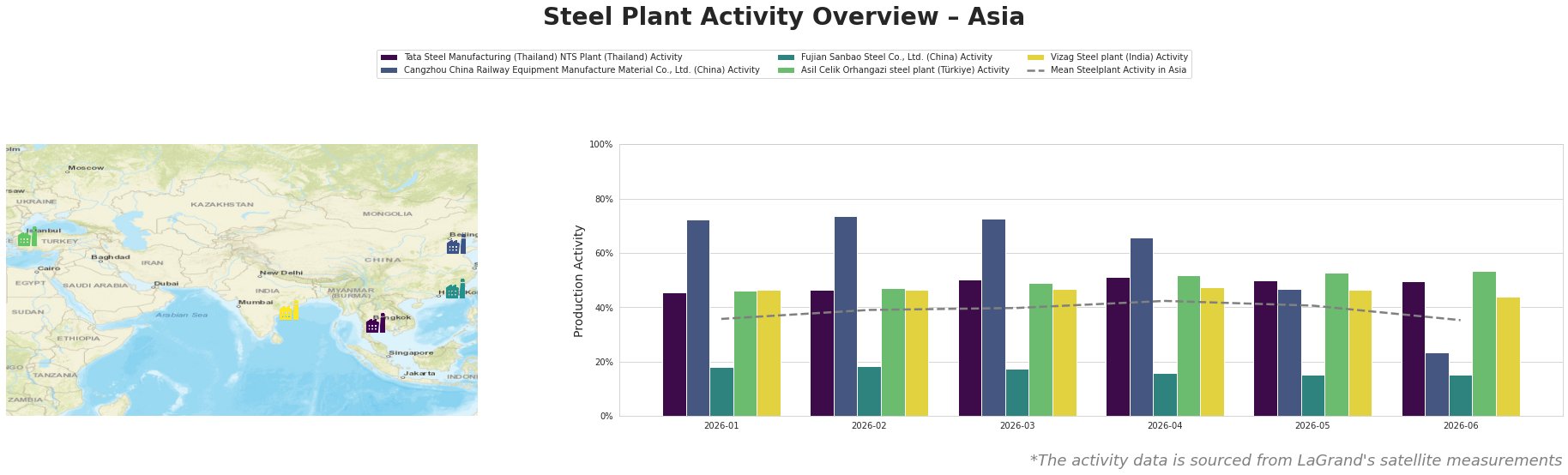
Activity levels among the surveyed plants show a worrying trend, particularly within Cangzhou China Railway Equipment Manufacture Material Co., Ltd., which experienced a significant drop to 23.0% of its capacity by June 30, 2026, matching cries for more effective competition strategies from the EU. In contrast, other plants mostly fluctuated within the 40%-54% range, reflecting a relatively more stable environment though still low compared to historical benchmarks.
The Tata Steel Manufacturing (Thailand) NTS Plant maintained stronger activity at 50.0%, hinting at more robust demand or operational capabilities. Conversely, Fujian Sanbao Steel Co., Ltd. and Vizag Steel Plant showed weak performances at 15.0% and 44.0%, respectively, lacking significant operational leverage against external pressures.
Procurement Strategies:
1. Tata Steel Manufacturing (Thailand) NTS Plant should be prioritized for sourcing as its activity levels remain relatively resilient amid market uncertainties. Buyers are encouraged to secure contracts with this plant due to its consistent performance.
2. Fujian Sanbao Steel Co., Ltd. and Vizag Steel Plant show vulnerability in their operational viability likely linked to market shorts; procurement from these plants should be approached with caution and limited to urgent needs.
3. Monitor changes in policy and competition, particularly in light of China: Zölle retten Europas Industrie nicht. A proactive adjustment to sourcing strategies in response to geopolitical shifts will be essential to mitigate potential supply disruptions.
Failure to adapt to these negative market signals could lead to unexpected procurement challenges for buyers engaging with weaker-performing plants in a tumultuous market environment.