


From the Field to the Dashboard – Built by Experts, for Experts.
Discover What's Really Happening in the Steel Industry
Use the AI-powered search engine to analyze production activity, market trends, and news faster than ever before.
Try the Free AI Search EngineAsia Steel Market Report: Activity Levels Steady Amid Mixed Export Trends
Recent data reveals that the steel market in Asia maintains a neutral sentiment bolstered by differing export trends observed in April 2026. The news articles titled “US merchant bar exports down 17.8 percent in April 2026 from March”, “US rebar exports down 14.9 in April 2026 from March”, and “US rebar imports up 45.9 percent in April 2026 from March” indicate a mixed scenario whereby export volumes are declining while imports are rising significantly. These trends are linked to varying levels of activity in key Asian steel plants, as evidenced by satellite observations.
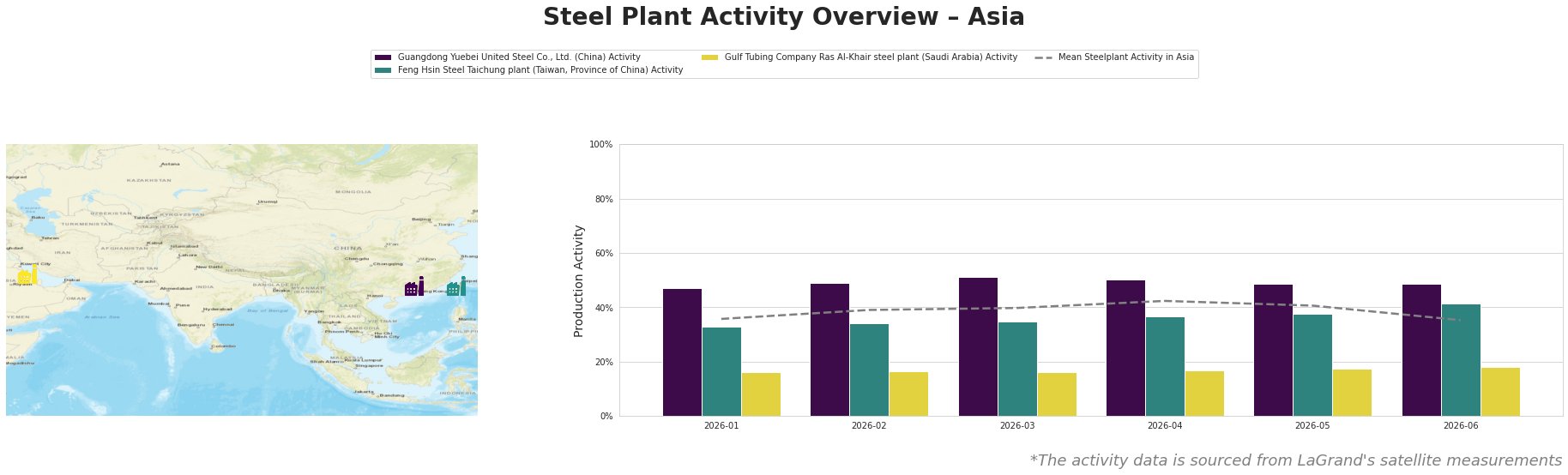
Activity at Guangdong Yuebei United Steel Co., Ltd. has shown stability with an April activity level of 50%, down slightly from 51% in March, yet comparable to the mean Asian activity of 42%. The recent significant decline in US merchant bar exports, coupled with general market conditions, suggests potential softness in the demand for related products, although no direct correlation can be established.
Feng Hsin Steel’s activity peaked at 41% in June, reflecting a steady demand for its diverse product offerings, despite the drop in exports of rebar from the US. As the plant primarily serves the domestic market, these developments may not immediately impact their operations.
Meanwhile, the Gulf Tubing Company shows a stable activity through small fluctuations that align with localized market demands rather than directly correlating with US export trends. Especially noted is a small rise to 18% in June, which suggests resilience in their production targets amidst external pressures.
Clear market implications arise from these observations. Potential disruptions appear localized, particularly for Guangdong Yuebei United Steel Co. due to the declining US export markets potentially impacting demand within Asia. Buyers in regions relying on this supply should consider optimizing their procurement strategies to accommodate possible fluctuations in availability.
To maintain a competitive edge, steel procurement professionals are advised to closely monitor import trends from South Korea, especially concerning rebar and related products given the 45.9% increase detailed in “US rebar imports up 45.9 percent in April 2026 from March”. Establishing relationships with South Korean suppliers may safeguard against potential local shortages while meeting increasing demand.