


From the Field to the Dashboard – Built by Experts, for Experts.
Discover What's Really Happening in the Steel Industry
Use the AI-powered search engine to analyze production activity, market trends, and news faster than ever before.
Try the Free AI Search EngineSlovakia’s Steel Market: Neutral Sentiment Amid Upcoming EAF Transition at Košice Steelworks
In Slovakia, recent developments including Nippon Steel plans EAF investment at Slovakia’s Košice steelworks and Nippon Steel plans to invest in EDP at Slovak steel plant in Kosice reveal strategic shifts in local steel production toward lower-emission methodologies. The proposed construction of an electric arc furnace (EAF) is expected to remain aligned with the existing operational capacity at the Košice facility while significantly cutting emissions. These plans highlight a forward-looking approach but offer temporary stability in production levels, as existing operations continue until the changes take effect.
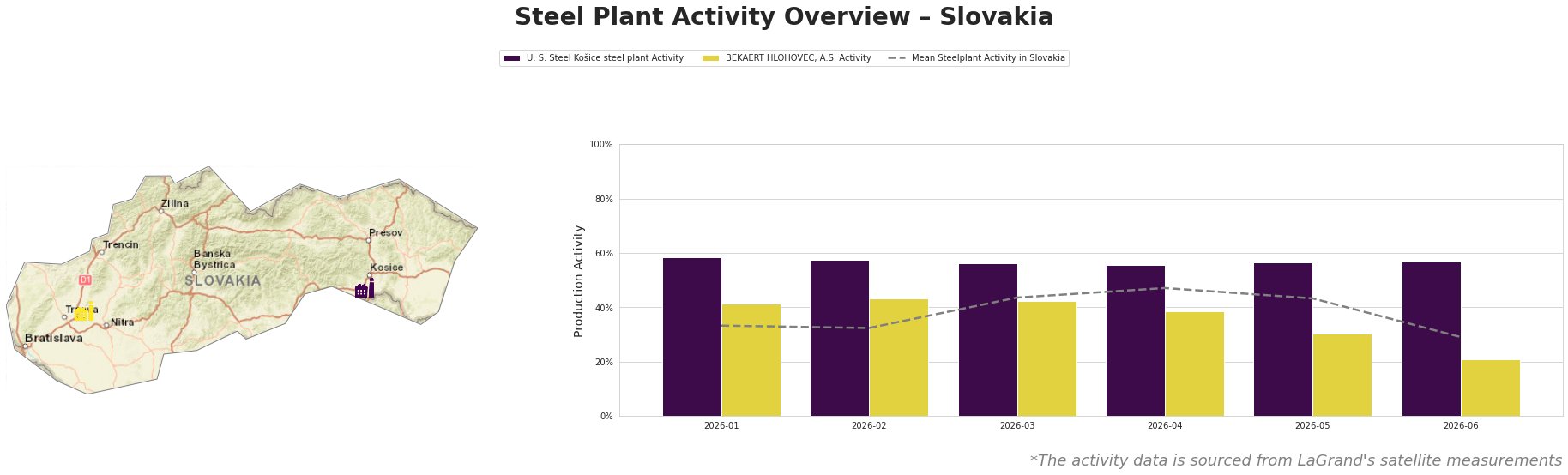
The U. S. Steel Košice plant shows relatively stable activity levels, averaging 56% across several months, peaking at 58% in January but observing a minor decline to 57% by June. In contrast, BEKAERT HLOHOVEC, A.S. displayed a downward trend, falling from 43% in February to 21% in June. No direct connections to the articles were evident for these fluctuations, indicating potential operational challenges at BEKAERT rather than the broader industry impacts indicated by Nippon Steel’s plans.
The U. S. Steel Košice plant, an integrated facility with a total capacity of 4.5 million metric tons, operates using basic oxygen furnace technology (BOF) and supplies various sectors including automotive and construction. The slight shift in activity to 57% in June may reflect operational adjustments as preparations for impending technological shifts take place, aligned with the news of future EAF integration.
Meanwhile, BEKAERT HLOHOVEC, A.S. operates using EAF technology primarily to produce wire rod for automotive and construction industries. The evident drop to 21% by June can be concerning, suggesting a need for closer monitoring of operational efficiencies and potential procurement adjustments against lower output levels.
Given these insights, buyers should prepare for potential supply fluctuations especially from BEKAERT HLOHOVEC. It would be advisable to secure contracts or additional inventory to mitigate risks of short supply. For U. S. Steel, maintaining current procurement practices might suffice in the near term, although close observation of EAF project timelines will be necessary to adjust strategies in 2028 and beyond as Nippon Steel begins full operations at the new EAF facility.