


From the Field to the Dashboard – Built by Experts, for Experts.
Discover What's Really Happening in the Steel Industry
Use the AI-powered search engine to analyze production activity, market trends, and news faster than ever before.
Try the Free AI Search EngineAsia’s Steel Market Faces Decline Amidst Production Cuts and Increasing Inventory Levels
The Asian steel market is currently grappling with significant challenges, highlighted by China’s 3.9% reduction in steel output from January to May 2026 as stated in “China reduced steel output by 3.9% y/y in January–May“. Concurrently, data shows a slight rebound in production during peak season as noted in “China’s crude steel output down 3.9 percent in January-May 2026, slight rebound in May“; however, this is undercut by rising inventory levels reported in “CISA mills’ daily crude steel output up 3.8% in early June 2026, stocks also up“.
Measured Activity Overview
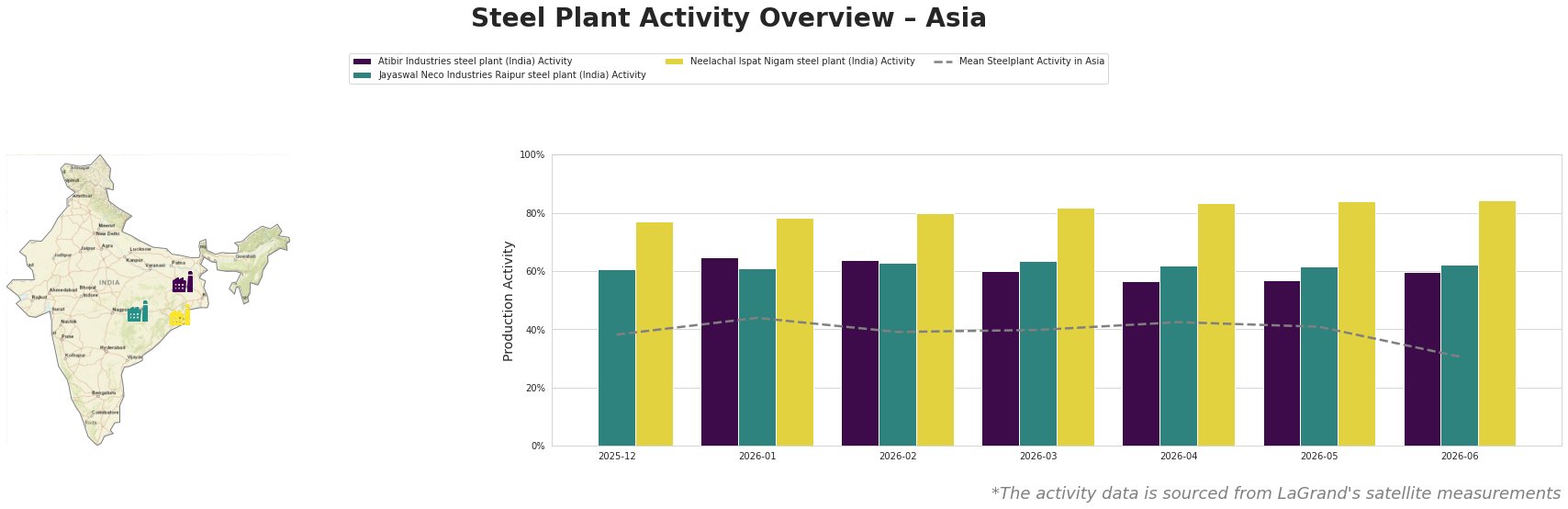
The average activity across steel plants in Asia has notably declined to 31.0% in June 2026, down from 41.0% in May 2026. The Atibir Industries steel plant showed a slight recovery to 60.0%, but this was insufficient to reflect broader market health. Conversely, the Jayaswal Neco and Neelachal Ispat Nigam plants maintained stable activity levels, but overall trends indicate significant underperformance, with mean activity levels well below previous months. These shifts correlate with the reported declines in production volumes and the increasing inventories highlighted in the related news articles.
Atibir Industries operates a modest capacity with integrated processes mainly involving Blast Furnace (BF) and Basic Oxygen Furnace (BOF) technologies. Despite reporting a rise to 60.0% in June, this increment fails to align with improvements in demand as steel output remains burdened by factors outlined in the connected news narratives.
Jayaswal Neco’s operational capacity of 1200 MT reflects resilience compared to the mean activity, yet its performance aligns with the general market downturn rather than indicating robust demand. The plant’s stable activity suggests it is holding onto production levels despite market pressures, as similar trends can be observed across the region due to the sluggish demand reflected in the news articles.
Neelachal Ispat Nigam, with a high capacity, reported stable activity levels; however, it too is unable to escape the overarching negative market sentiment dictated by the drop in Chinese crude steel production and rising inventories.
Evaluated Market Implications
The combination of reduced output and rising inventory positions indicates potential supply disruptions across Asia, especially in response to the patterns observed in China’s production declines as detailed in “China’s crude steel output down 3.9 percent in January-May 2026, slight rebound in May”. This scenario suggests a deteriorating demand outlook amidst bearish market conditions driven largely by domestic market challenges in China.
Steel buyers should consider immediate procurement adjustments, focusing on plants like Jayaswal Neco and Neelachal Ispat Nigam, where activity is comparatively more stable. Engaging in forward contracts or maintaining flexible supply agreements with these facilities may mitigate risks associated with potential supply shortages as inventory levels loom high. Additionally, strategic inventory management practices may prove crucial in navigating the current volatile environment and aligning with demand forecasts, which presently remain pessimistic.