


From the Field to the Dashboard – Built by Experts, for Experts.
Discover What's Really Happening in the Steel Industry
Use the AI-powered search engine to analyze production activity, market trends, and news faster than ever before.
Try the Free AI Search EnginePositive Outlook for Asia’s Steel Market Amidst Global Overcapacity Challenges
Recent developments in the Asian steel market indicate a positive sentiment despite rising global overcapacity concerns. According to the OECD: Global steel overcapacity deepens: OECD (2026-06-04), the projected overcapacity is expected to reach 745 million tonnes by 2028, driven particularly by China’s increasing steel exports, which saw a record high of 131 million tonnes in 2025 despite weakened domestic demand. This is further reflected in the activities of major plants in the region.
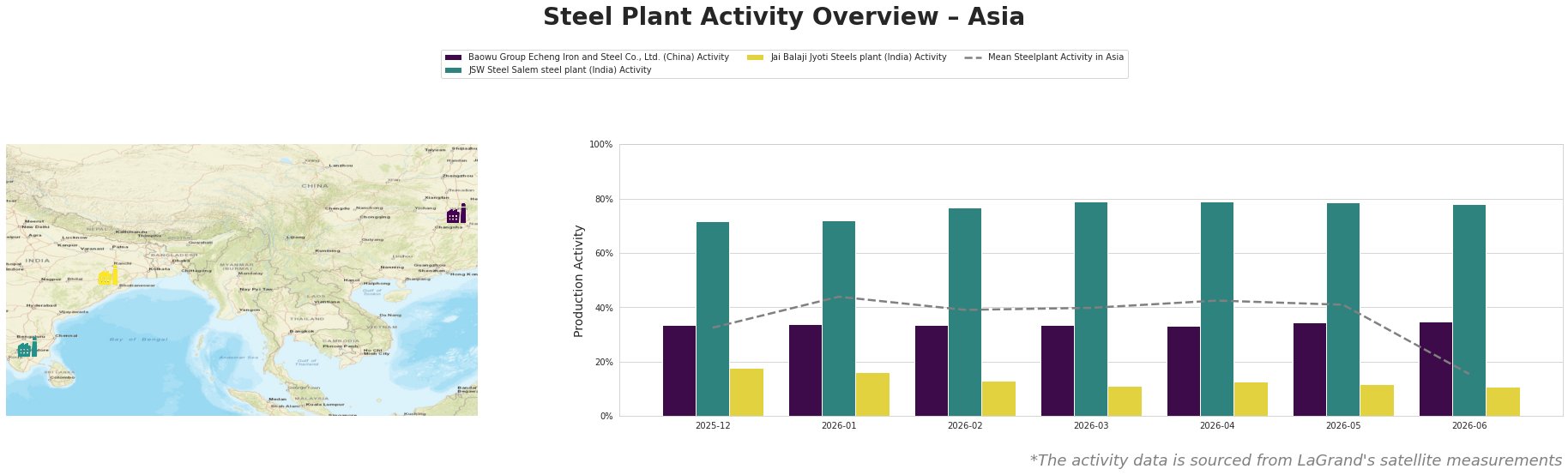
The activity levels of Baowu Group Echeng Iron and Steel Co., Ltd. showed a slight peak at 35% in June 2026, which, while modest, reflects ongoing resilience amid the broader overcapacity context referenced in the OECD: Global steel excess capacity set to reach 745 million mt by 2028 (2026-06-04). This slight uptick may indicate efforts towards stabilization in production.
JSW Steel Salem remains robust with activities averaging in the mid-high 70% range, peaking at 79% in March and April, suggesting steady demand particularly for infrastructure projects, a sector mentioned in the plant’s product detail. The drop to 78% in June may correlate with the anticipated decreases in global steel demand cited in OECD: Global steel trade shifts as China’s exports hit record high despite weak world trade (2026-06-05), highlighting the potential impact of Chinese export dynamics on regional competitors.
Conversely, Jai Balaji Jyoti Steels has seen a troubling trend, with a gradual decline in activity levels, peaking at only 18% in December 2025 and dropping to 11% by June 2026. This downturn aligns with stagnating consumption patterns noted by the OECD, indicating that this plant may face significant challenges due to excess capacity in the market.
The satellite data indicates a potentially pressing supply risk in regions heavily reliant on capacity from Jai Balaji, as declining activity could lead to insufficient supply in the regional construction sectors. Steel buyers should prioritize sourcing from stable producers like JSW Steel Salem and Baowu to mitigate potential disruptions tied to varying demand dynamics.
In conclusion, steel buyers are advised to focus procurement on actively performing plants with stable production (JSW Steel and Baowu) while closely monitoring ongoing shifts in the market driven by excess capacities and external trade policies highlighted in the OECD reports.