


From the Field to the Dashboard – Built by Experts, for Experts.
Discover What's Really Happening in the Steel Industry
Use the AI-powered search engine to analyze production activity, market trends, and news faster than ever before.
Try the Free AI Search EngineEU Steel Market Thrives Amid New Safeguard Measures and Increased Investment Activity
Recent developments in the European steel market signal a very positive outlook, driven largely by the implementation of new safeguard measures approved by the EU on June 8, titled “The EU has approved new safeguard measures on steel imports“. This legislative change aims to fortify fair competition and transparency within the EU steel sector, coinciding with satellite-observed surges in factory activities, particularly in regions less affected by global oversaturation. The German Steel Federation’s positive reception of these safeguards is echoed in the article “German Steel Federation welcomes EU’s new safeguard quota measures,” which outlines how these measures create a balanced environment for steel production, particularly in Germany.
Measured Activity Overview
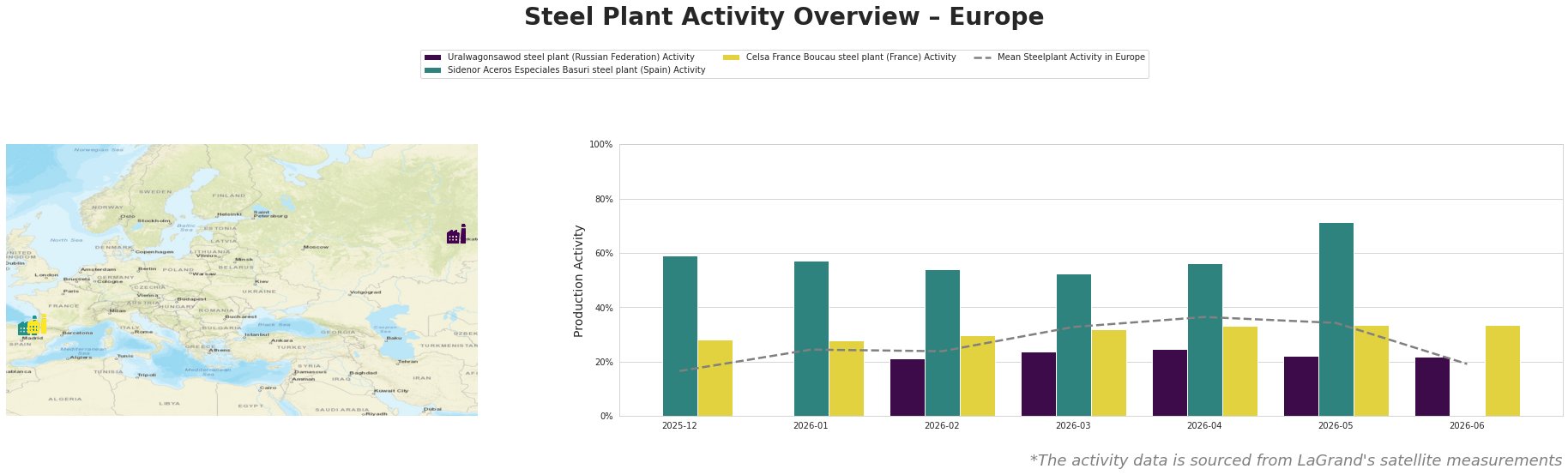
From the table, we see that Sidenor Aceros Especiales Basuri reached a peak activity level of 72.0% in May, significantly higher than the mean activity of 34.0% during that month. This sharp rise could be related to the new investments in the European steel sector outlined in the article “European steel industry attracts new investments,” highlighting increased production capabilities. Conversely, Uralwagonsawod reported lower activity levels, remaining at 22.0% by June, reflecting the lingering impacts of global market conditions, yet no direct connection to the safeguard measures is evident.
Plant Narratives
The Uralwagonsawod steel plant is currently under-performing at 22.0% (June). Its operational capacity, specific processes, and the usage of technologies are undisclosed, which hinders direct correlations to the recent EU regulations.
In contrast, the Sidenor Aceros Especiales Basuri steel plant, which specializes in EAF-based production of finished rolled goods, recorded a remarkable activity peak of 72.0% in May. This increase suggests strong alignment with the favorable conditions fostered by the new EU safeguard measures and intensified investment opportunities in the sector, as noted in “European steel industry attracts new investments.”
Lastly, Celsa France Boucau, which maintains a more stable operational level at 33.0%, reflects consistent market demand within its specialized categories. Its activity levels barely fluctuate, which indicates its resilience amidst the evolving European landscape, yet no specific link to recent regulatory changes can be directly established.
Evaluated Market Implications
The EU’s new safeguard measures are poised to mitigate the risk of supply disruptions while stabilizing pricing in the steel market, particularly benefiting EU-based producers and associated jobs. Steel buyers should prioritize procurement from high-activity plants such as Sidenor and Celsa to ensure a steady supply amidst uncertainty. Furthermore, considering the projected 18.3 million tonnes annual import quota, buyers should closely monitor import levels exceeding the thresholds to avoid incurring excessive tariffs.
Steel analysts are encouraged to track performance trends from active plants, ensuring strategic procurement that aligns with overall market shifts driven by new protective regulations. In contrast, sourcing from lower-activity plants may present risks, particularly if regional political tensions escalate or if shifts occur in global supply dynamics. Direct engagement with suppliers from high-performance facilities is strongly advisable to maintain competitive advantages amidst a rapidly evolving steel market.