


From the Field to the Dashboard – Built by Experts, for Experts.
Discover What's Really Happening in the Steel Industry
Use the AI-powered search engine to analyze production activity, market trends, and news faster than ever before.
Try the Free AI Search EngineDeclining Steel Market Activity in Europe: Analyzing Weak Demand and Supply Challenges
The European steel market is facing significant challenges as recent reports highlight a persistent decline in demand. Notably, the article “European steel heavy plate prices dip in Italy; Northern Europe stable on slow demand” indicates that weak demand has led to reduced activity levels in Italian steel plants. This is further substantiated by a decrease observed at key production facilities, as noted in satellite data.
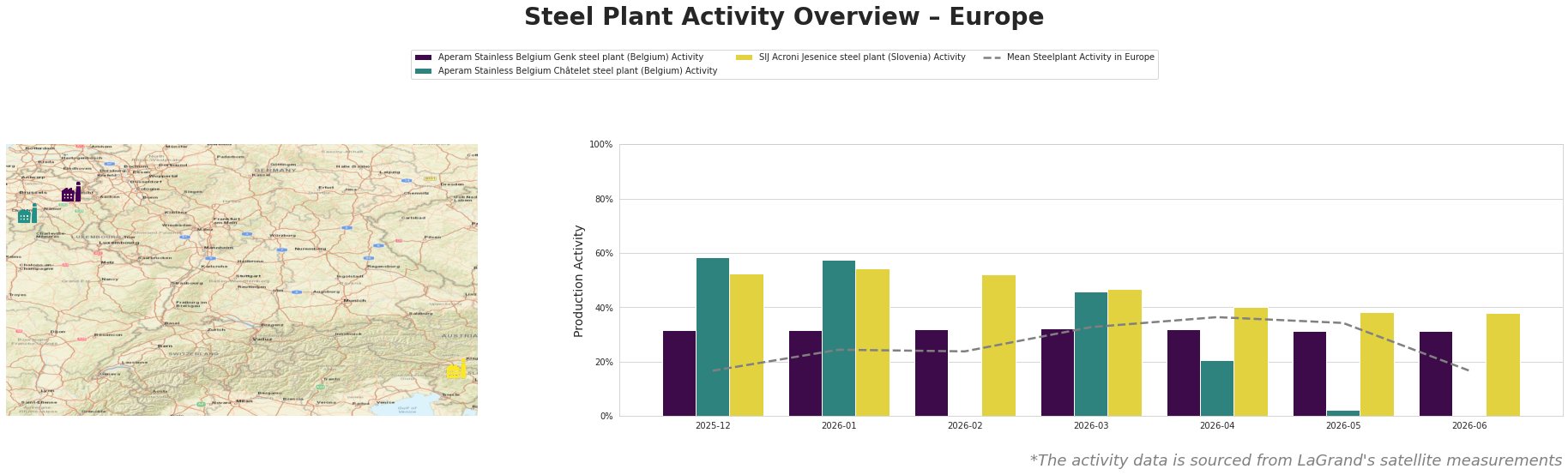
Activity levels across European steel plants have shown significant fluctuations, with a notable drop in overall mean activity to 17% observed in June 2026. Particularly, Aperam Stainless Belgium Châtelet’s activity plunged to 2% in May, aligning with the lack of urgency in bookings for summer deliveries as reported in “European sheet metal prices in Italy are declining; Northern Europe is stable due to low demand.” This is symptomatic of the broader market’s struggle, where inventory caution has curtailed operations at various plants.
Aperam Stainless Belgium Genk has maintained relatively stable activity levels, holding around 31-32%, despite overall market pressures. However, its output trajectory appears stagnant, which may be a precaution against anticipated further declines in demand. On the other hand, SIJ Acroni Jesenice’s activity fell moderately from 47% in March to 38% in June, which may reflect the ongoing challenges faced by the sector, as described in the article “Prices for Italian plates are stabilizing amid a lull in the market.” Yet, the steady state of operations at both Aperam plants may not be sufficient to withstand forthcoming demand decreases.
Procurement professionals should be aware of the potential supply disruptions, particularly from SIJ Acroni Jesenice and Aperam Châtelet, where activity drops indicate constraints that could lead to tighter supply conditions for flat rolled steel products. Immediate actions are recommended: buyers should secure contracts ahead of anticipated price increases due to expected import reductions and protected local sales driven by the EU’s trade measures. Additionally, evaluating local suppliers may provide some competitive advantage as supply shifts may favor regional players. Given the reported slow trading environment, adaptability in sourcing and pricing strategies will be essential to navigate these negative market sentiments effectively.