


From the Field to the Dashboard – Built by Experts, for Experts.
Discover What's Really Happening in the Steel Industry
Use the AI-powered search engine to analyze production activity, market trends, and news faster than ever before.
Try the Free AI Search EngineSteel Market in Oceania Faces Downturn Amid Limited Demand and Plant Activity Declines
The Oceania steel market exhibits a negative sentiment characterized by declining plant activity and cautious demand. Recent reports from European steel HRC prices rise, trading limited and European domestic HRC markets quiet; buyers resist higher levels amid ample inventories reflect low trading volumes and buyer reluctance, which align with observed decreases in plant activity across the region.
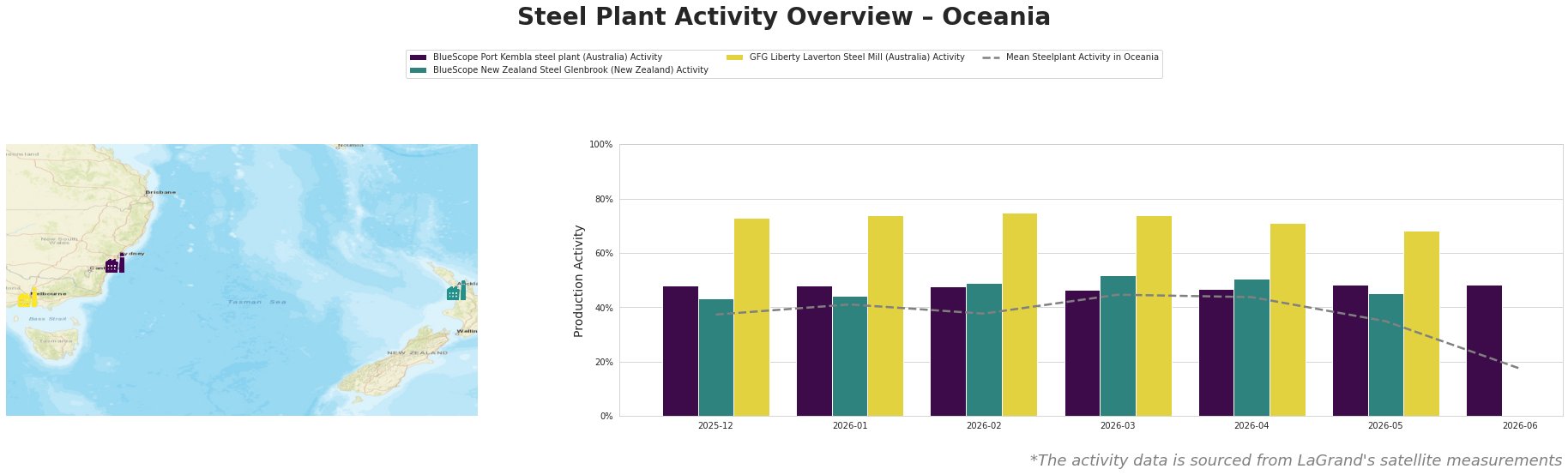
Recent activity reveals a significant downturn, particularly notable in June 2026, where mean activity plunged to 18%, reflecting heightened caution among buyers as stated in the news articles. Notably, European HRC steel prices are rising, trade is limited highlights how the broader market dynamics impact the regional suppliers in Oceania, potentially causing volatility in observed activity levels.
The BlueScope Port Kembla steel plant in New South Wales reported stable activity around 48%, though signs of stagnation are visible since the dip to 35% in May is concerning. This aligns indirectly with low trading volumes of HRC in Europe, where buyers are hesitating due to high inventories.
BlueScope New Zealand Steel Glenbrook’s activity reflects a lower engagement, especially with a consistent activity percentage of 45% observed alongside reports indicating that demand remains subdued, creating a challenging environment for new contracts. Links to The HRC market in the EU shows modest domestic demand, while import trade is low due to uncertainty about quotas imply uncertainty which may also be affecting decision-making behaviors and operational capacities in Oceania.
At the GFG Liberty Laverton Steel Mill, activity declined to 68%, significantly lower than preceding months, which reflects the broader trend of caution as outlined in news reports about inventory statuses. This reduced activity combines with the findings in European domestic HRC markets quiet; buyers resist higher levels amid ample inventories, suggesting a parallel effect as local buyers resist market price increases and instead hold onto existing inventory.
To address these current market conditions, buyers should consider the following procurement actions:
– Secure contracts quickly from BlueScope Port Kembla due to its stable output, but negotiate prices aggressively mindful of declining demand trends.
– Monitor BlueScope New Zealand Steel Glenbrook for potential overstock situations that could force down prices, leveraging their reduced activity against inventory levels reported in European markets.
– For GFG Liberty Laverton, assess immediate needs carefully; consider waiting for further price stabilization before large procurements, as external factors may continue to influence regional stability.
In conclusion, product availability seems sufficient, but price negotiations are advised to be flexible in light of inventory surpluses reflected within both local and global markets.