


From the Field to the Dashboard – Built by Experts, for Experts.
Discover What's Really Happening in the Steel Industry
Use the AI-powered search engine to analyze production activity, market trends, and news faster than ever before.
Try the Free AI Search EngineGermany’s Steel Market Sees Positive Activity Trends Amid Political Developments
Germany’s steel market is experiencing an overall positive sentiment, driven by rising activity levels at key plants. Notably, satellite observations indicate increased operations at BGH Edelstahl Freital and Riva Brandenburg Electric Steel Works, coinciding with the political discussions surrounding “a liberal restart” in the country as reported in Liveblog Bundespolitik: Kubicki will keine Rücksicht auf Strack-Zimmermann-Flügel nehmen | FAZ. Furthermore, changes in the political landscape could align with the ongoing enhancements in the steel industry.
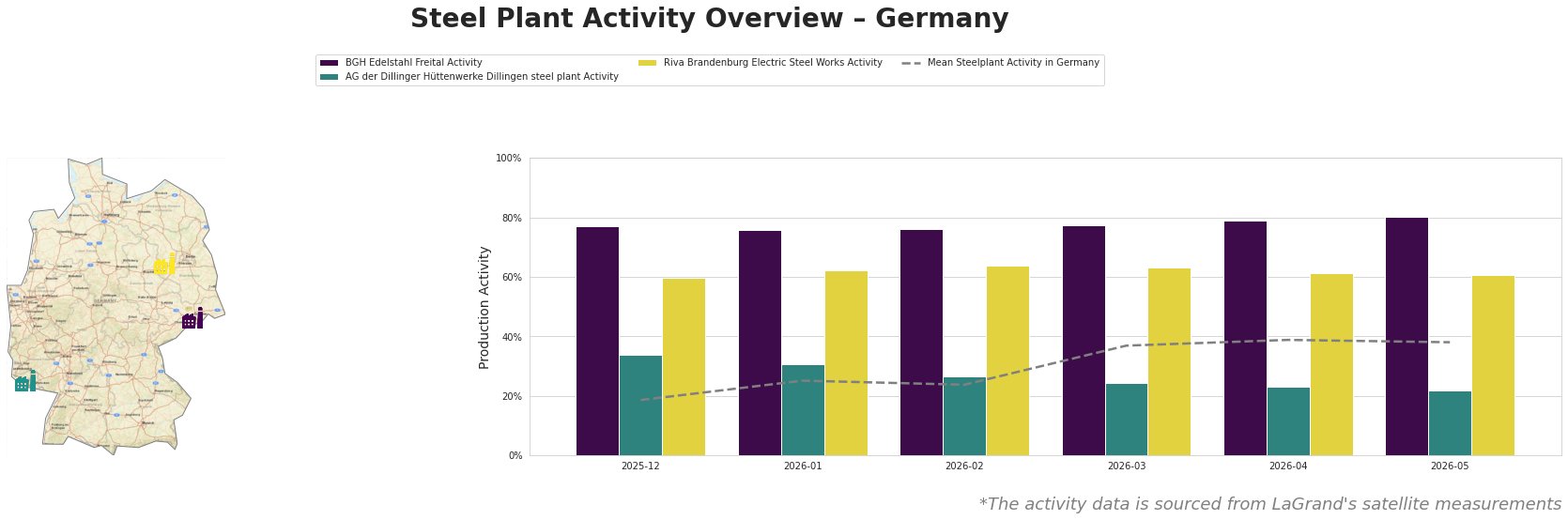
Activity levels have notably escalated for BGH Edelstahl Freital, reaching 80% in May 2026, indicating a strong recovery and consistent output. This aligns with the political emphasis on innovation and sustainability in the industry, as communicated by Angela Merkel in her remarks on renewable energy initiatives. In contrast, AG der Dillinger Hüttenwerke Dillingen observed a slight decline to 22%, potentially reflecting operational adjustments during ongoing political transitions but lacks direct linkage to recent political articles. Meanwhile, Riva Brandenburg Electric Steel Works experienced stable operations around 61%, with no clear correlation to existing political discourse.
BGH Edelstahl Freital not only focuses on producing stainless steel and special alloys but also plays a critical role in sectors like sustainable energy and automotive, which are expected to grow due to renewed political support for green initiatives. The increase in their production capability points towards a strategic alignment with current market demands amid Germany’s evolving political climate. The plant operates using electric arc furnace (EAF) technology and employs approximately 700 workers, serving diverse markets, thus highlighting its importance in the industry’s future growth dynamics.
Conversely, AG der Dillinger Hüttenwerke’s comprehensive operations in various high-demand specialties could face challenges if political decisions regarding funding and policies do not support continued innovation and production efficiency. Procurement professionals are urged to monitor these developments closely, especially in strategic sectors like automotive and energy.
The positive trajectory in steel production, particularly at BGH Edelstahl Freital, suggests that steel buyers should prioritize sourcing from this plant, given its robust production potential and alignment with renewable energy goals. Meanwhile, analysts should prepare for potential supply shifts if trends continue, especially at AG der Dillinger Hüttenwerke, where operational adjustments may be necessary in light of fluctuating political landscapes. Monitoring activity levels across these key plants will be essential for informed decision-making in procurement strategies.