


From the Field to the Dashboard – Built by Experts, for Experts.
Discover What's Really Happening in the Steel Industry
Use the AI-powered search engine to analyze production activity, market trends, and news faster than ever before.
Try the Free AI Search EngineAsia Steel Market Report: Strong Activity Growth Amid Positive Economic Developments
Recent trends in the Asian steel market reflect a Very Positive outlook, driven by sustained increases in manufacturing capacities across key regions. Higher activity levels in Japanese plants, particularly noted in JFE West Japan Works (Fukuyama and Kurashiki), have coincided with the findings in “US adds 115,000 jobs in April, jobless rate flat“ and “US inflation hits 3-year high in April on war,” linking stronger local production to upbeat economic indicators.
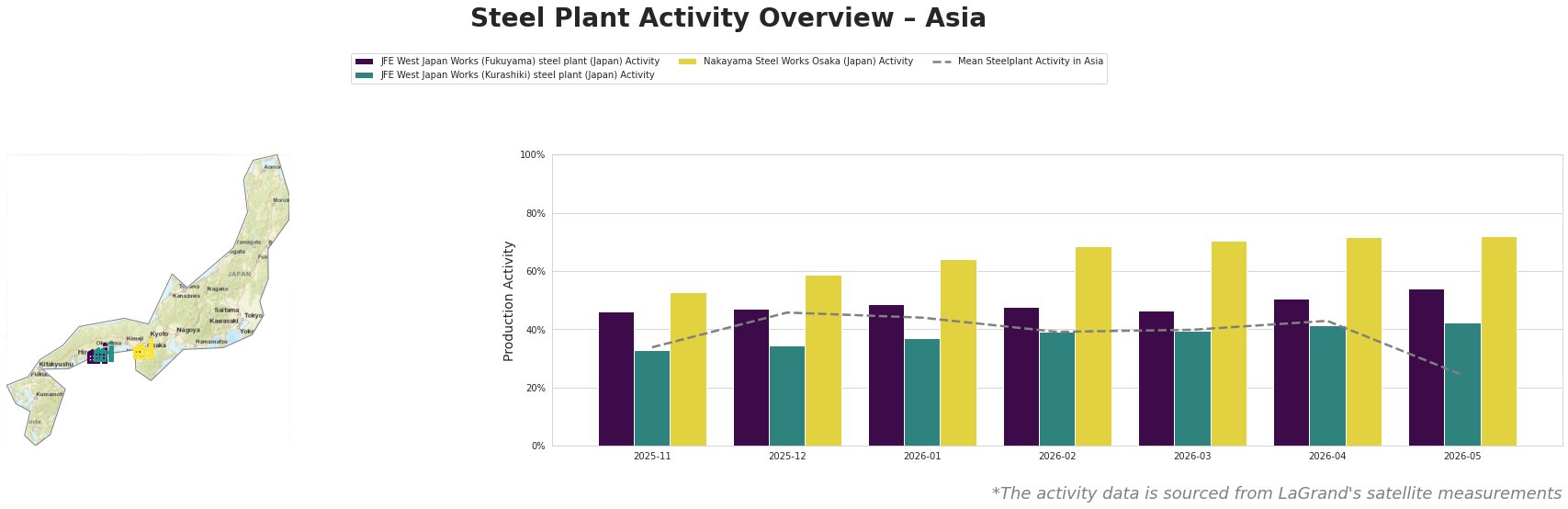
JFE West Japan Works (Fukuyama) exhibits a notable increase in activity, peaking at 54% in May following a 51% level in April. This uptick aligns with favorable employment data in the U.S., implying potential increased demand for steel products across sectors like automotive and construction. However, the later drop to 24% indicates a volatility that could affect supply stability; attention is warranted on production scheduling.
Meanwhile, JFE West Japan Works (Kurashiki) maintains steady growth, achieving 42% activity in May, having been influenced by the economic recovery highlighted in the job report. No direct correlation can be established with inflation impacts as per recent articles.
Nakayama Steel Works Osaka reached an impressive activity level of 72% in both April and May, supported by robust demand dynamics despite higher costs announced in the “US producer inflation surges by 6pc in April“. This positive environment may allow for strategic sourcing opportunities due to current market conditions.
Evaluating potential supply disruptions, Fukuyama’s fluctuations present a key risk for buyers, suggesting adjusting procurement strategies based on stable procurement options from Kurashiki and Osaka, which have shown consistent activity trends. Buyers should consider hedging against potential supply instability at Fukuyama while maintaining a strong engagement with Osaka to secure favorable pricing, especially in light of increasing energy costs impacting overall production economics.
In conclusion, stakeholders are advised to monitor activity alerts closely, particularly at Fukuyama, weigh potential shifts in supply based on observed trends, and proactively engage with plants demonstrating stable high-output performance.