


From the Field to the Dashboard – Built by Experts, for Experts.
Discover What's Really Happening in the Steel Industry
Use the AI-powered search engine to analyze production activity, market trends, and news faster than ever before.
Try the Free AI Search EnginePositive Market Outlook for Europe’s Steel Sector Amid Growing Decarbonization Efforts
Germany’s strategic investment in industrial decarbonization is set to impact the steel market positively. The announcement in the article titled Germany will allocate €5 billion for the decarbonization of heavy industry has coincided with increased activity at various European steel plants observed through satellite data, particularly at ArcelorMittal Méditerranée Fos sur Mer and Iron Ozone 32.
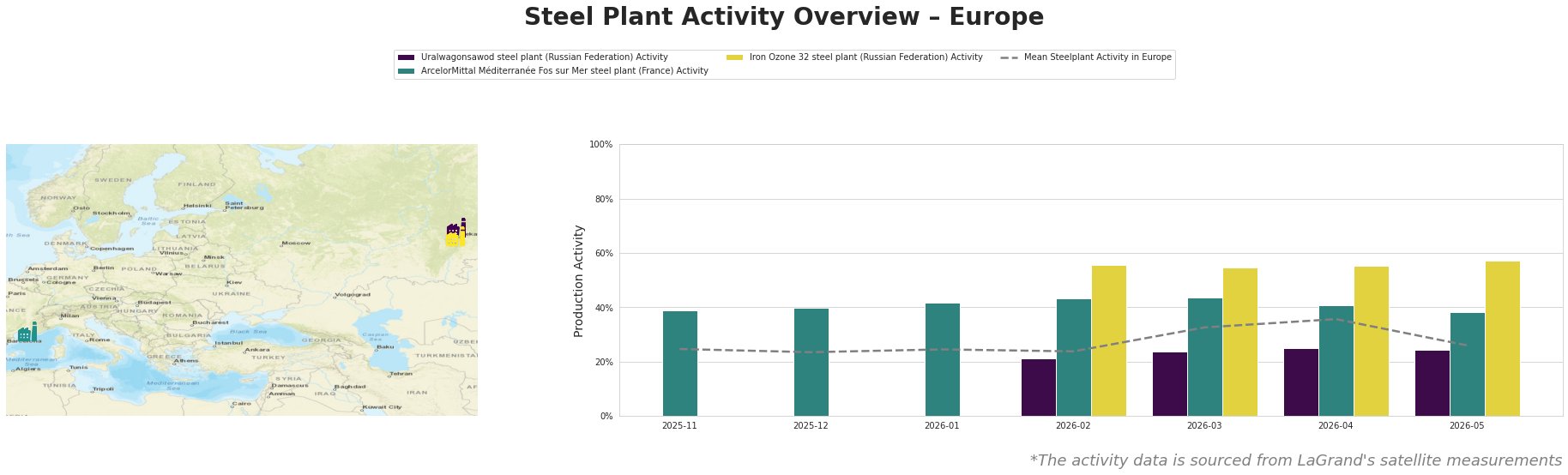
Uralwagonsawod’s activity remained steady at around 24% by May 2026, reflecting underlying issues that are not directly linked to recent funding announcements. The plan highlighted in Germany allocates €5 billion for decarbonization of industry posits that sectors like steel are expected to benefit significantly, potentially recovering operational input for Uralwagonsawod moving forward.
ArcelorMittal Méditerranée Fos sur Mer displayed fluctuating levels of activity, peaking at 43% in February before stabilizing around 38% by May. This seasonal drop, however, does not detract from the overall positive market sentiment, as it still operates significantly above earlier averages. These dynamics align with Germany’s funding efforts to bolster production efficiencies through the article Germany’s EUR 5 billion funding plan for industrial decarbonization projects approved, which aims to implement cost-effective carbon reduction measures imperative for sustaining competitiveness in a transitioning market.
Iron Ozone 32 experienced a remarkable increase in activity, reaching a peak of 57% in May 2026. This surge could be positively correlated with funding aimed at promoting green technologies, as per The EU has allocated over €1 billion to hydrogen projects aimed at decarbonization. Enhanced electrolyzer capacity may be fostering the plant’s output through greener energy, which is critical in light of the competitive landscape shaped by investments in low-carbon initiatives.
European steel procurement professionals should monitor potential supply disruptions linked to low activity at Uralwagonsawod, which may not fully harness the benefits from governmental decarbonization initiatives. Consequently, it is prudent to consider securing supply commitments from higher-performing facilities like ArcelorMittal Méditerranée Fos sur Mer and Iron Ozone 32, where operational dynamism aligns synergistically with public investments in innovation and emission reductions. Strategic allocation towards these proactive suppliers can ensure continuity and stability in procurement amidst evolving regional policies.