


From the Field to the Dashboard – Built by Experts, for Experts.
Discover What's Really Happening in the Steel Industry
Use the AI-powered search engine to analyze production activity, market trends, and news faster than ever before.
Try the Free AI Search EngineAsia Steel Market Report: Current Trends and Activity Overview Amid Stabilizing Demand
The steel market in Asia remains neutral as global production experiences declines, notably marked by Global production has been declining for the seventh month in a row, which revealed a decrease of 4.2% in March. This decline aligns with satellite observations indicating decreased activity at major steel plants in the region, specifically around Guangdong and Fujian.
As illustrated in the table below, the activity levels of notable steel plants have seen varying changes over recent months:
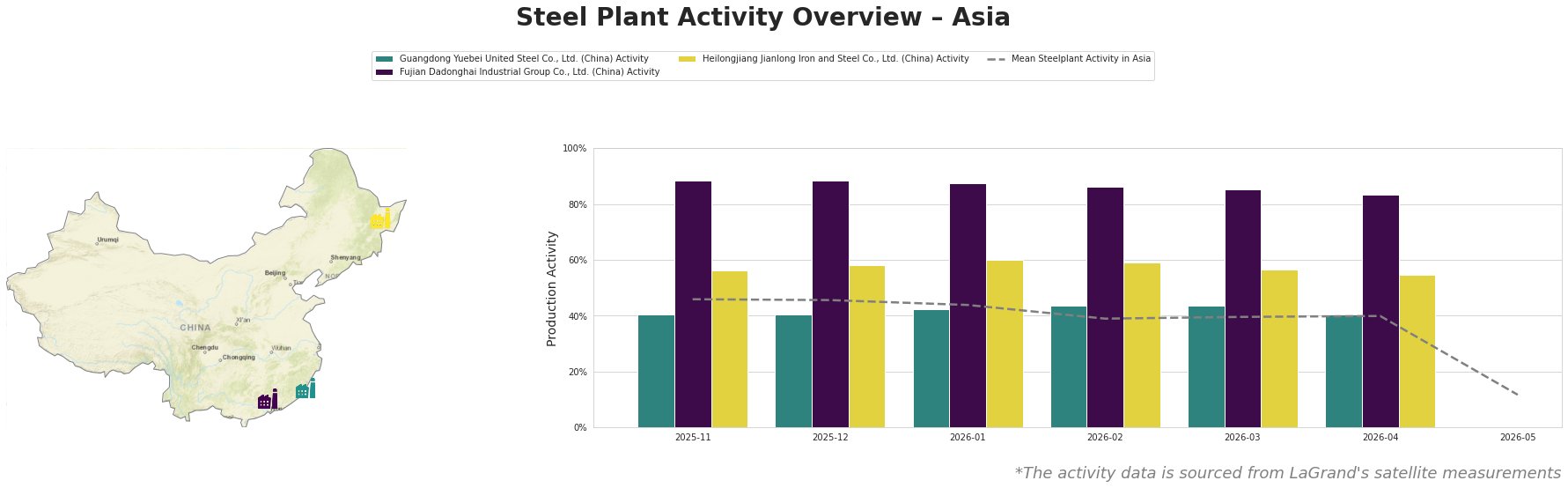
Guangdong Yuebei United Steel Co., Ltd. exhibited a notable decrease from 44% in March to 41% in April, signaling a potential downward trend that could reflect broader market conditions as stated in IREPAS: Global steel market steadies amid weaker growth. Meanwhile, Fujian Dadonghai Industrial Group Co., Ltd. saw a reduction as well, sliding from 85% in March to 84% in April, supporting the decline reported in Chinese production levels. Heilongjiang Jianlong Iron and Steel Co., Ltd. experienced a similar trend, from 57% to 55%, yet remains above the mean activity level of 40%.
The decline in activity can be attributed to multiple factors outlined in various news articles, including the looming energy costs and geopolitical tensions from The Middle East conflict is a stress test for steel markets which highlights impacts on operational expenses and demand forecasting.
For operating plants, potential supply disruptions may arise due to these decreased output levels and geopolitical pressures affecting logistics. Steel buyers are advised to closely monitor these developments since the decline in output may alter supply availability and pricing.
In conclusion, procurement strategies should consider securing contracts early and exploring alternative suppliers, particularly in India, where production is expected to rise by 9.4% amid the overall stagnation in other parts of Asia. The recent stabilization at significantly lower activity levels suggests that buyers might encounter tighter bidding conditions and increased costs as highlighted by Raw Material Suppliers at IREPAS: Tighter supply, geopolitics reshape global scrap market.