


From the Field to the Dashboard – Built by Experts, for Experts.
Discover What's Really Happening in the Steel Industry
Use the AI-powered search engine to analyze production activity, market trends, and news faster than ever before.
Try the Free AI Search EngineChina Steel Market Sentiment Deteriorates Amidst Declining Activity and Geopolitical Tensions
China’s steel market faces serious challenges as recent satellite data shows a significant decline in production activity tied to weak demand, exacerbated by geopolitical factors and regulatory shifts. According to the article Traders at IREPAS: Geopolitical tensions and higher costs disrupt steel trade flows, China’s crude steel output is projected to drop amid a struggling construction sector. This aligns with satellite observations indicating an overall mean activity level of just 5% in May 2026, a stark decrease from previous months.
The ongoing changes in plant activity highlight this negative sentiment. For example, Guangdong Yuebei United Steel Co., Ltd. experienced a consistent decline, with activity levels dropping from 41% in November 2025 to 5% by May 2026. This significant drop correlates with insights from the article Raw Material Suppliers at IREPAS: Tighter supply, geopolitics reshape global scrap market, where tight supplies and escalating costs due to geopolitical tensions were discussed, impacting production capabilities.
Fujian Dadonghai Industrial Group Co., Ltd. has also noted reduced activity, although it remained higher at 88% before recent sanctions and trade complexities took hold. In contrast, Heilongjiang Jianlong Iron and Steel Co., Ltd. exhibited relatively stable activity around 85%-89%, although a looming decline appears imminent given the overall market atmosphere.
Recent Monthly Activity Overview
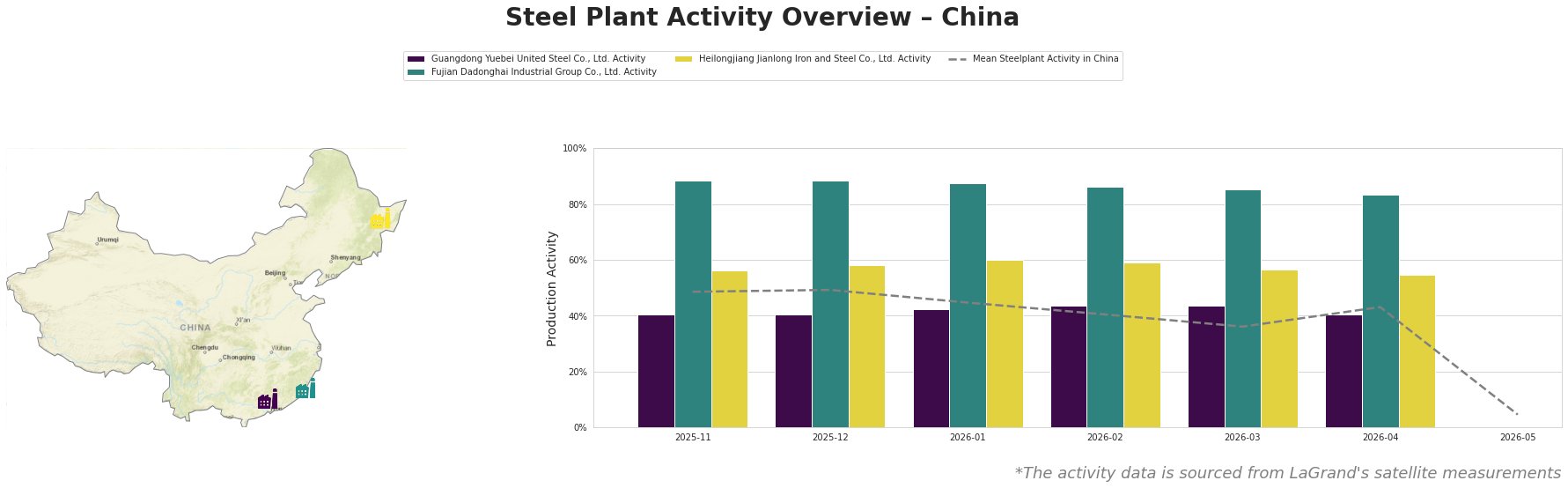
Evaluated Market Implications
The significant drop in activity at Guangdong Yuebei United Steel Co., Ltd. suggests potential supply disruptions, particularly impacting rebar availability, crucial in the residential and infrastructure sectors. With specific details noted in the article “Traders at IREPAS: Geopolitical tensions and higher costs disrupt steel trade flows,” buyers should proactively assess alternative suppliers or stock levels to mitigate risks associated with supply shortages.
Fujian Dadonghai and Heilongjiang Jianlong, while currently maintaining slightly higher activity levels, cannot be relied upon to stabilize the segment due to their fluctuating operational capacities amid the prevailing uncertainties associated with global trade dynamics. Procurement actions should focus on immediate sourcing from stable suppliers and diversify contracts to buffer against geopolitical disruptions highlighted in the recent news.
In summary, buyers should closely monitor these developments, prioritize strategic sourcing, and remain adaptive to rapidly shifting market dynamics to ensure their supply chains remain resilient against anticipated challenges.