


From the Field to the Dashboard – Built by Experts, for Experts.
Discover What's Really Happening in the Steel Industry
Use the AI-powered search engine to analyze production activity, market trends, and news faster than ever before.
Try the Free AI Search EngineSteel Market Outlook: Asia Faces Severe Downturn Amidst Trade Tensions
Recent developments in Asia’s steel market indicate a very negative outlook driven by significant trade tensions and fluctuating production activities. The news articles titled “Welthandel im Wandel – Die WTO muss reformiert werden, doch die Fronten sind verhärtet“ and “Welthandel im Wandel – Die WTO soll reformiert werden – doch wie ist umstritten“ highlight ongoing conflicts within the WTO, particularly involving the US and China, which may contribute to instability in steel supply chains.
In line with these developments, satellite monitoring has revealed marked declines in activity across major steel plants. For instance, the Ansteel Group Chaoyang Steel & Iron Co., Ltd. has seen a drop from 76% in November 2025 to just 80% in March 2026, while the average activity across Asian steel plants has decreased from 45% to 32% during the same period. Notably, JFE’s Kurashiki and Fukuyama facilities maintained relatively stable outputs of 32% and 39% respectively, indicating a divergence in regional plant performance amid market pressures.
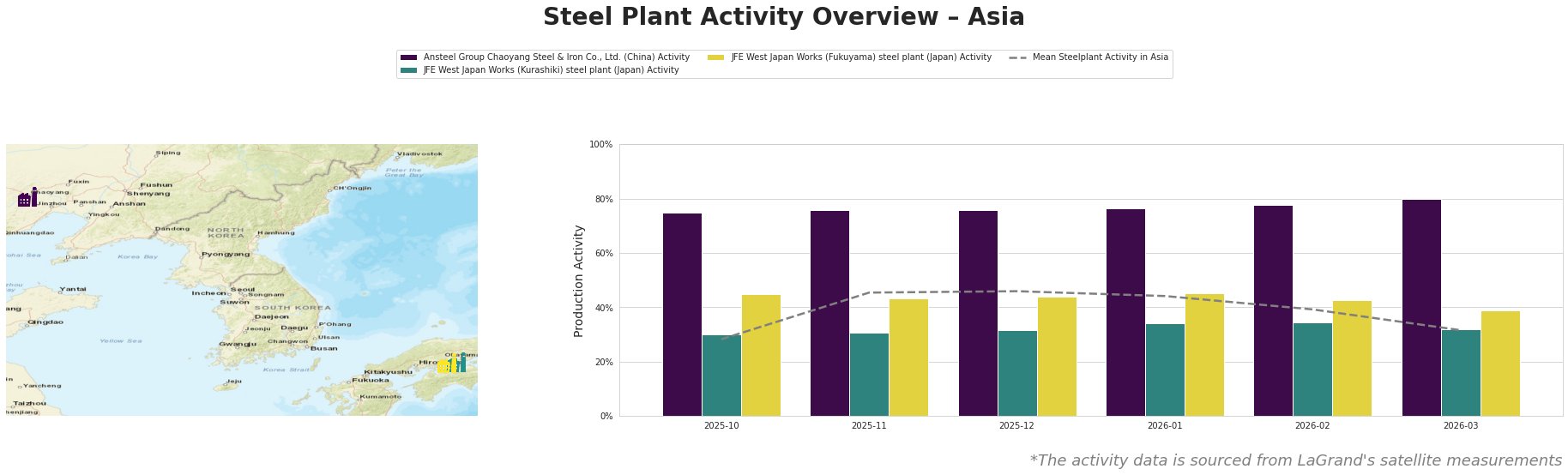
The Ansteel Group, based in Liaoning, has a crude steel capacity of 2.1 million tons utilizing integrated BF and BOF technologies. Its recent rise to 80% production levels could reflect efforts to capitalize on perceived short-term market opportunities, potentially destabilized by trade uncertainties.
Conversely, the JFE West Japan Works (Kurashiki) and Fukuyama plants, with capacities of 10 million tons and 13 million tons respectively, have shown resilience with activity levels at 32% and 39%. This steady output may indicate strategic adjustments amidst heightened trade tensions, primarily driven by the need to manage costs in response to the broader economic environment as outlined in the aforementioned articles.
Given these observations, procurement professionals should consider:
-
Anticipated Supply Disruptions: Activity volatility at Ansteel may signify a forthcoming shortfall. Adjust contracts and inventory strategies accordingly to mitigate risk.
-
Strategic Sourcing: Engage with JFE’s operations, which are currently more stable, for reliable supply options amidst fluctuating Asian market conditions.
-
Focus on Regional Dynamics: As negotiations within the WTO remain contentious, keeping abreast of policy shifts related to trade tariffs will be crucial in sourcing decisions.
This evolving scenario underscores the importance of agile procurement strategies that account for geopolitical and market-driven uncertainties impacting steel availability in Asia.