


From the Field to the Dashboard – Built by Experts, for Experts.
Discover What's Really Happening in the Steel Industry
Use the AI-powered search engine to analyze production activity, market trends, and news faster than ever before.
Try the Free AI Search EngineSteel Market Report for Asia: Activity Declines Amidst WTO Reforms Push
Recent developments in Asia’s steel market reveal a very negative outlook. Reports titled “Welthandel unter Trump: Ist die WTO reformierbar?” and “Welthandel im Wandel – Die WTO soll reformiert werden – doch wie ist umstritten” discuss the pressing need for reform within the World Trade Organization (WTO) as member states face increasing fragmentation, particularly between the US and China. Such geopolitical tensions are mirrored in drastic reductions in steel plant activity, as evidenced by satellite observations.
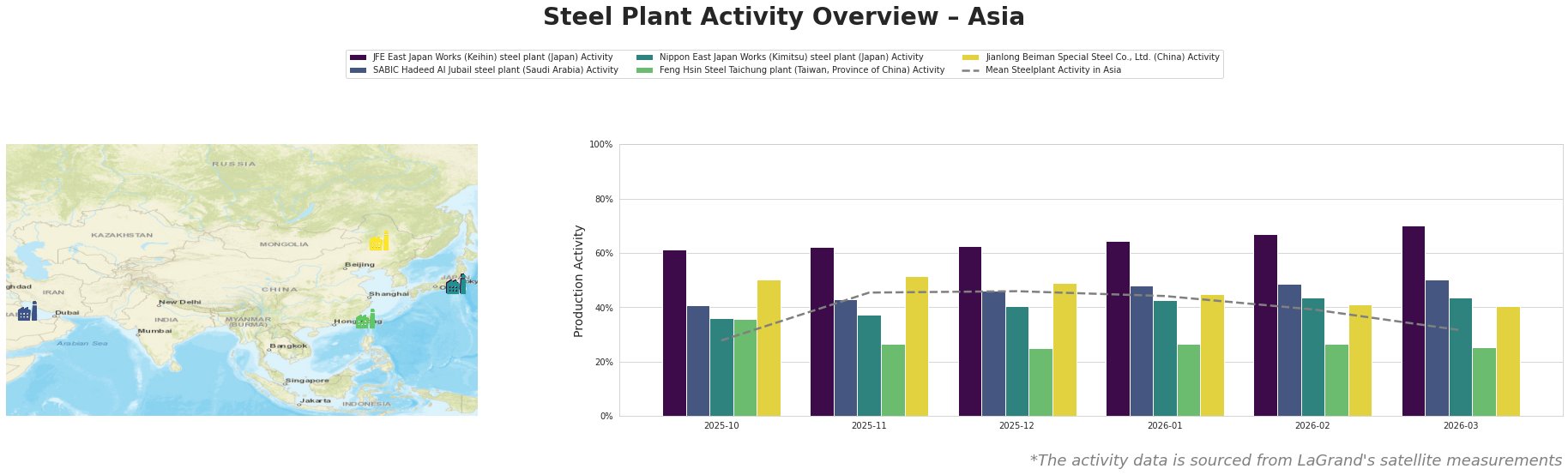
The JFE East Japan Works (Keihin) exhibited a surge up to 70% in March 2026, while experiencing minor adjustments previously. Nevertheless, as per the report “Welthandel im Wandel – Die WTO muss reformiert werden, doch die Fronten sind verhärtet”, the scrutiny and challenges in global trade policies may cause uncertainties influencing continued operations.
Conversely, the SABIC Hadeed plant saw fluctuating activity, peaking at 50% in March 2026. Issues surrounding raw material accessibility could develop as the WTO’s trade frameworks remain unstable, impacting productivity at such facilities.
Feng Hsin Steel’s activity dropped sharply to 25% by the end of March 2026 from earlier highs, directly impacted by market fears of overcapacity and import restrictions related to WTO negotiations. Such comparative declines suggest potential supply shortages in semi-finished products, potentially affecting buyers depending on Taiwanese imports.
The Jianlong Beiman plant in China demonstrated the lowest activity comparison, settling at 40% in March, indicating challenges in meeting production demands due to regulatory pressures suggested by ongoing WTO discussions.
Steel procurement professionals in Asia should actively consider diversifying their supply sources. With fluctuations noted in notable facilities, particularly in the context of the issues raised in “Welthandel im Wandel – Die WTO soll reformiert werden – doch wie ist umstritten”, it is advisable to secure contracts earlier than usual to mitigate the potential risk of sudden price hikes or supply shortages.
Implementing strategic partnerships with regions less affected by these trade tensions—such as Southeast Asia—could also prove beneficial in the approaching months as the geopolitical landscape evolves.