


From the Field to the Dashboard – Built by Experts, for Experts.
Discover What's Really Happening in the Steel Industry
Use the AI-powered search engine to analyze production activity, market trends, and news faster than ever before.
Try the Free AI Search EnginePositive Steel Market Outlook for Asia: Growth in India Amidst Global Challenges
The Asia steel market exhibits a positive sentiment as evidenced by growing activity in key regions. Recent news articles, including “India, US, Germany output buck global trend again“ and “Global pig iron production fell by 1.2% y/y in January–February“, reveal that while China faces a production decline of 2.7%, India has improved its output by 6.1%. This trend correlates with observed increases in satellite data, showing notable activity in plants across Asia, particularly in India.
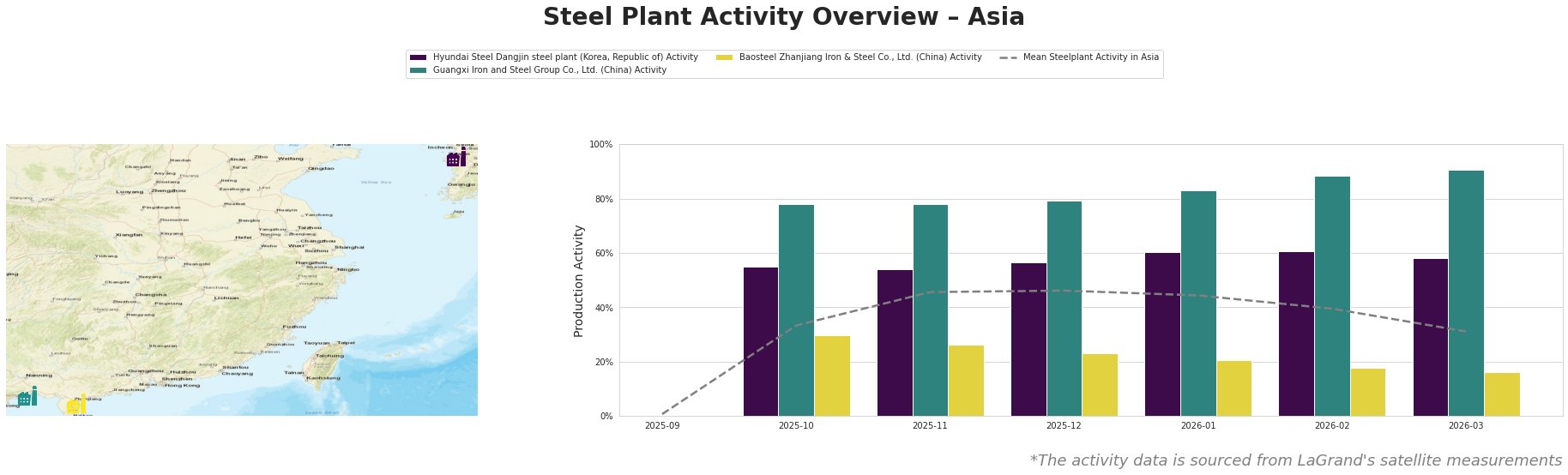
The Hyundai Steel Dangjin plant shows variability, peaking at 61.0% in February 2026 but declining to 58.0% by March 2026, which is not directly linked to recent news developments. The Guangxi Iron and Steel Group has displayed a remarkable increase, achieving a peak of 90.0% in March, against the backdrop of reduced production in China detailed in “Global pig iron production fell by 1.2% y/y in January–February.” The Baosteel Zhanjiang plant shows a downward trend, decreasing from 21.0% in January to 16.0% in March with no established direct connection to the news.
Hyundai Steel operates with a capacity of 16,600 tons of crude steel, predominantly using a BF process, which aligns with its activity levels suggesting stable operations despite emerging challenges. Meanwhile, Guangxi’s strong performance, with a capacity of 9,200 tons and focusing on BOF, demonstrates resilience amidst the downturn in Chinese production. However, Baosteel’s output drop aligns with the broader trend of decreased steel production in China, as stated in the “Global pig iron production fell by 1.2% y/y in January–February”.
Considering the current landscape, steel buyers should closely monitor supply receipts and production schedules from Indian plants, particularly in light of India’s growth indicated in the article “India, US, Germany output buck global trend again.” Given the reported resilience in Indian production, procuring steel from Indian sources may help mitigate potential supply disruptions arising from declines in Chinese output. Additionally, with activity at Guangxi Iron and Steel reportedly increasing, sourcing from this plant may provide opportunities for competitive pricing aligned with regional market dynamics. By focusing procurement strategies on higher-performing plants within India and strategic Asian counterparts, steel buyers can better navigate the uncertainties posed by declining global production rates.