


From the Field to the Dashboard – Built by Experts, for Experts.
Discover What's Really Happening in the Steel Industry
Use the AI-powered search engine to analyze production activity, market trends, and news faster than ever before.
Try the Free AI Search EngineUkraine Steel Market: Activity Declines Amidst Supply Challenges and Reduced Exports
Recent assessments indicate a stagnation in the steel industry across Ukraine, influenced by external market pressures and domestic production limitations. Notably, the article Global steel production fell by 2.2% y/y in February highlights a significant 9.9% output decrease in Ukrainian steel production to 515,000 tons in February due to constrained operational capacity, which aligns with declines observed at local steel plants. Additionally, the article Ukraine reduced exports of long steel products by 64.4% y/y in January–February reveals further contraction in international demand exacerbating the industry’s challenges.
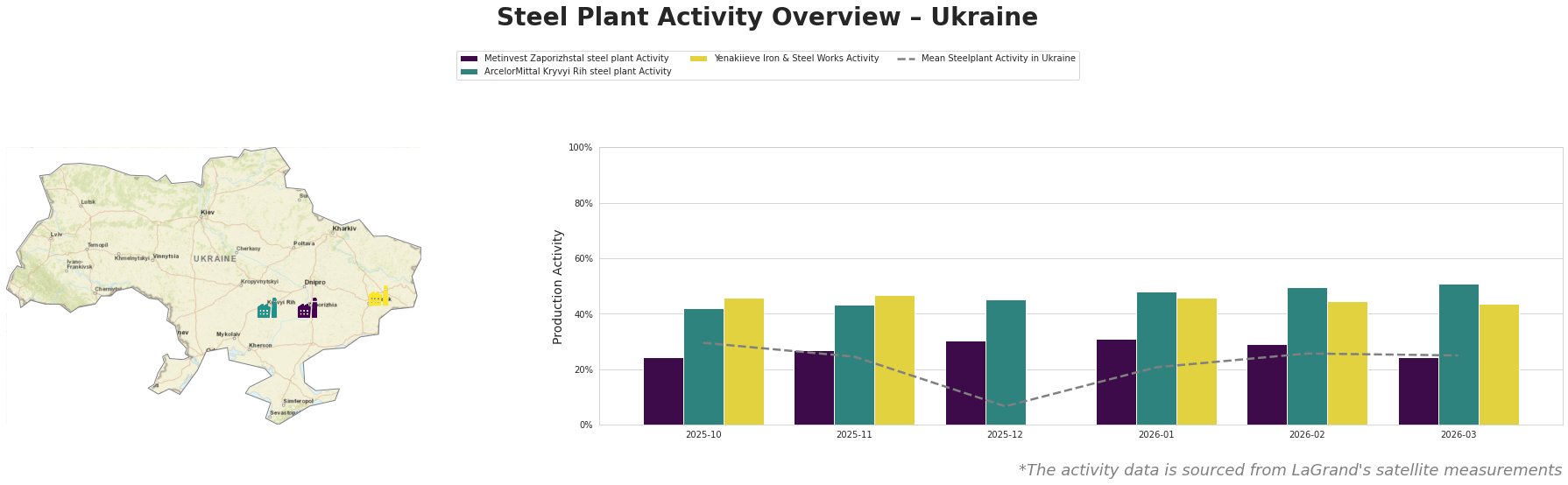
Plant activity has undergone considerable fluctuations, with Metinvest Zaporizhstal reported at 24.0% in March, down from a peak of 31.0% in January, which may correlate with the industry’s broader export decline noted in the Global steel production fell by 2.2% y/y in February article. ArcelorMittal Kryvyi Rih illustrates relatively better performance, reaching 51.0% in March, though still reflecting a subdued demand scenario as seen in the noted export drop. Conversely, Yenakiieve Iron & Steel Works showed stable yet low levels, remaining affected amid operational and resource availability challenges.
The reduction in coke imports by 21.1% as cited in Ukraine reduced imports of steel coke by 21.1% y/y in January–February further reflects issues regarding raw material sourcing, corresponding with the decline in operation levels of plants, particularly given 64% of mining operations are out of control.
Supply disruptions are anticipated particularly in the long steel products segment and areas reliant on imported coke. Procurement specialists should consider diversifying their supplier base to mitigate risks associated with supply chain dependencies on specific nations, like Poland, as highlighted in the reduction of coke imports. Additionally, buyers may need to adjust their strategies to cope with increasing costs linked to the EU market tied in with changes from export markets that are not being met by local supply, detrimental to the competitiveness of products as elaborated in the Ukraine reduced exports of long steel products by 64.4% y/y in January–February. Evaluating alternatives or halting reliance on low-demand steel types may serve as crucial strategies moving forward.