


From the Field to the Dashboard – Built by Experts, for Experts.
Discover What's Really Happening in the Steel Industry
Use the AI-powered search engine to analyze production activity, market trends, and news faster than ever before.
Try the Free AI Search EnginePositive Momentum in Europe’s Steel Market Amidst Variability in Production
In Europe, the steel market is experiencing a positive sentiment driven by contrasting production levels across key regions. Notably, Germany increased steel production by 4.8% y/y in February, which aligns with satellite observations indicating a solid uptick in production activity at various plants. Conversely, Ukraine reduced exports of long steel products by 64.4% y/y in January–February, reflecting the challenges stemming from geopolitical tensions, although no direct correlation to satellite data could be established.
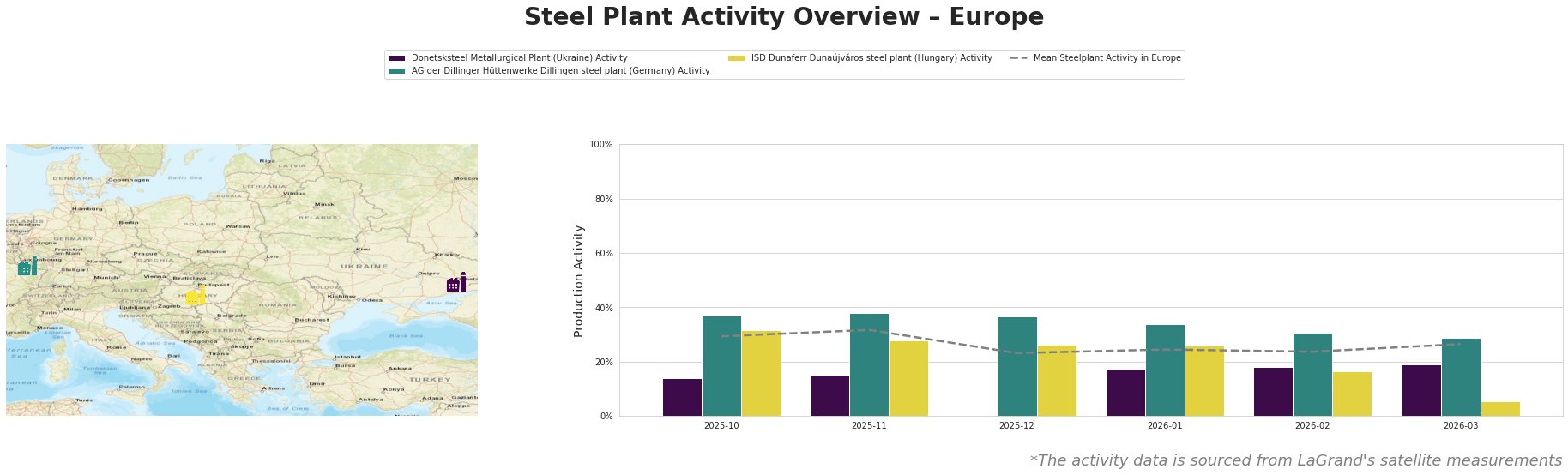
The Donetsksteel Metallurgical Plant has shown a gradual increase in activity from 14.0% in October to 19.0% in March 2026. However, overall operations remain hindered due to the ongoing conflict, limiting its production capabilities, thus correlating with OECD cuts Ukraine’s steelmaking capacity estimate to 8 mln t.
The AG der Dillinger Hüttenwerke demonstrates a relatively stable upper productivity level, although it dipped to 29.0% in March from a peak of 38.0% in November. This sustained production capability aligns with the robust demand from the automotive and construction sectors mentioned in the same context as reported by Germany increased steel production by 4.8% y/y in February.
In contrast, ISD Dunaferr Dunaújváros has faced notable declines, falling to only 6.0% activity in March, marking a substantial drop from 32% in October. This activity drop does not directly link back to any specific news articles but indicates systemic challenges within the Hungarian steel sector.
Evaluating market activity indicates potential supply disruptions, particularly related to Ukrainian steel production. Given that Ukraine reduced exports of long steel products by 64.4% y/y, steel buyers should anticipate short-term fluctuations in pricing linked to Eastern European supply challenges.
Steel procurement professionals are advised to:
– Prioritize sourcing from German steel plants like AG der Dillinger Hüttenwerke due to their operational stability and capacity enhancements, which currently show positive production trends.
– Assess long-term contracts with Ukrainian suppliers cautiously, given their limited operational capacity and declining export capabilities, especially in light of the ongoing geopolitical challenges.
– Retain flexibility in sourcing strategies to adapt to varying supply responses from different European regions, particularly as shifts in the political landscape may impact output positively or negatively in the near future.