


From the Field to the Dashboard – Built by Experts, for Experts.
Discover What's Really Happening in the Steel Industry
Use the AI-powered search engine to analyze production activity, market trends, and news faster than ever before.
Try the Free AI Search EngineAustria’s Steel Market Faces Turbulence: Activity Levels Drop Amid Supply Concerns
Recent developments in Austria’s steel market reflect a negative sentiment, primarily influenced by external factors affecting fuel supply and production dynamics in key plants. The activities of Voestalpine’s facilities in Linz and Donawitz have seen notable decreases, as highlighted by the satellite monitoring data correlating with market shifts.
The recent article “Australia establishes fuel supply taskforce“ underscores the rising concern regarding fuel availability, which directly impacts operational efficiencies across Austria’s steel manufacturing processes. While the linkage to local activity changes is indirect, the news indicates potential struggles in logistics that could exacerbate existing issues.
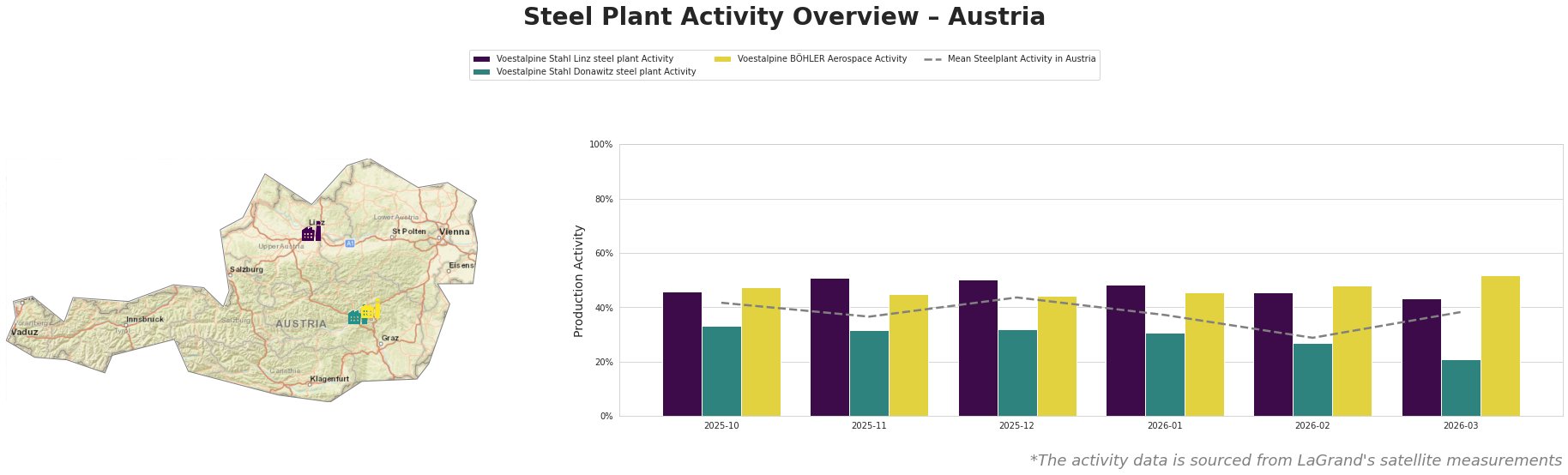
Voestalpine’s operations in Linz and Donawitz reflect a decline in activity levels, with Linz’s functionality dropping from 51.0% in November to 43.0% in March, and Donawitz experiencing a sharper decrease from 33.0% to 21.0% over the same period. The latter is particularly concerning, as it may suggest assembly or supply chain vulnerabilities amid tightening fuel supplies. Additionally, the BÖHLER Aerospace plant reported an increase to 52.0% in March, showcasing less volatility but not directly correlating with any recent news developments.
The Voestalpine Stahl Linz steel plant, an integrated facility with a crude steel capacity of 6,000 tonnes, has maintained a complex operational process alongside continuous production of various steel strips. The noted activity drop aligns with the broader market tumult stemming from uncertainty about fuel logistics stemming from the article “Australia’s Ampol to delay Lytton refinery turnaround,” where projections about fuel availability have contributed to operational hesitancy.
The Voestalpine Stahl Donawitz steel plant has also faced disruptions in its integrated processes, exhibiting a worrying dip of 10 percentage points in March, raising questions about its supply chain resilience potentially influenced by the external factors identified in the news, albeit no direct causality was confirmed.
In light of the ongoing market disruptions, procurement strategies should be adjusted by focusing on securing contracts with reliable suppliers who possess robust local production capabilities. It is advisable for buyers to monitor the developments surrounding local fuel supply chains closely and consider preemptive procurement of readily available stock to mitigate potential shortages driven by logistical challenges. Evaluating suppliers’ operational stability based on the observed plant activity deviations may also prove essential in minimizing risk in this oscillating market landscape.